
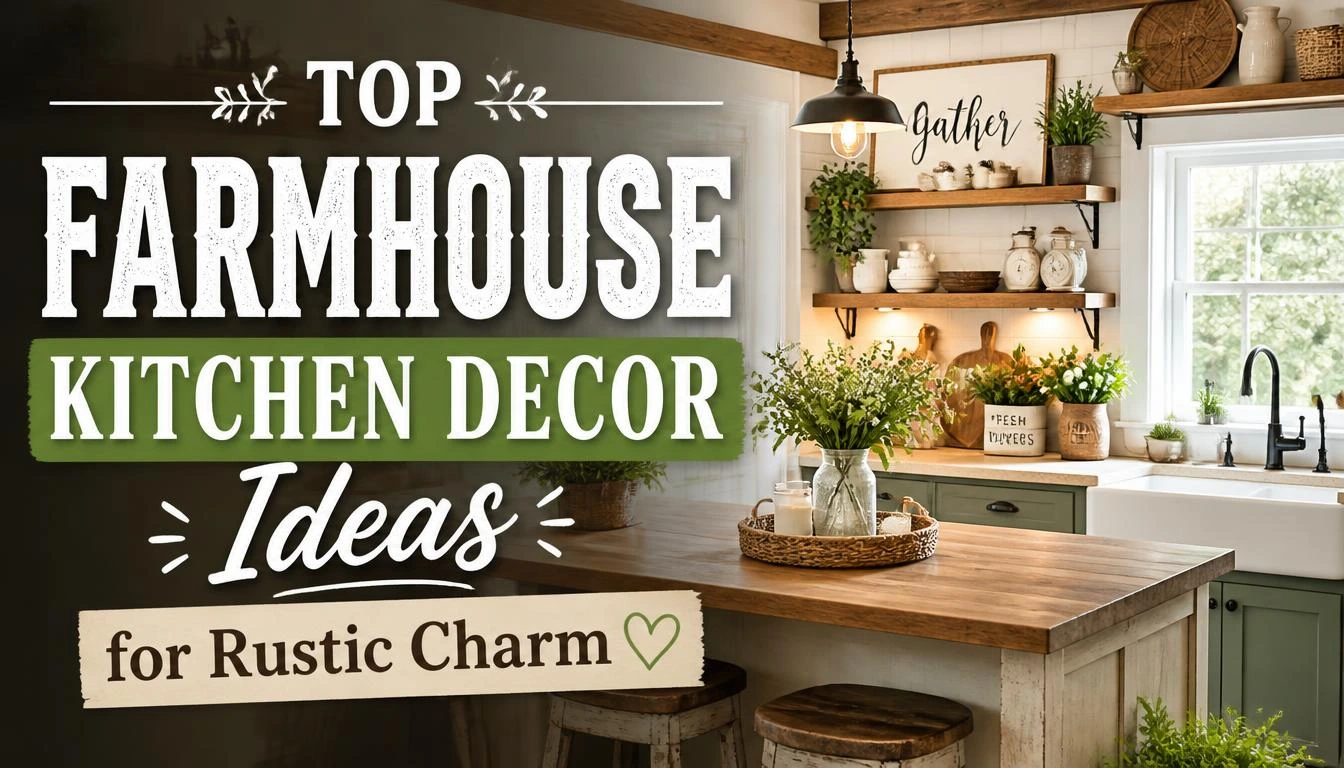
The top farmhouse kitchen decor ideas for rustic charm occupy an interesting middle ground between a design aesthetic that has been so thoroughly commercialized that the word farmhouse now appears on mass-produced subway tile at big box stores and the genuine warmth of a working kitchen that accumulated its character over decades of actual use. I have been in both kinds of farmhouse kitchens, the styled ones and the real ones, and the difference comes down to whether the room looks like it was decorated to look like a farmhouse kitchen or whether it looks like people have been cooking, gathering, and living in it for years. The ideas below lean deliberately toward the second outcome.
What Farmhouse Kitchen Style Actually Means Beyond the Shiplap
Farmhouse kitchen style has been reduced in popular culture to a checklist of specific elements: shiplap walls, open shelving, subway tile, apron front sinks, and mason jars repurposed as everything. These elements can all contribute to a genuine farmhouse aesthetic, but applied without understanding the underlying principles they produce a room that looks like a farmhouse kitchen set rather than a farmhouse kitchen.
The underlying principles that make a farmhouse kitchen feel genuinely warm and characterful rather than styled are function-first design, honest materials that show their nature and age gracefully, layered accumulation rather than coordinated purchasing, and the specific quality of a room that looks like it works hard and is loved for it. A farmhouse kitchen displays its tools because they are used. It has open shelving because reaching for what you need should be immediate rather than requiring cabinet navigation. It uses natural materials because those were available, durable, and beautiful in the context of a working kitchen.
Rustic charm specifically comes from the imperfection and variation that natural materials carry and that manufactured alternatives cannot replicate: the grain variation in a wood countertop, the slightly uneven surface of handmade ceramic, the patina that develops on brass hardware over years of handling, and the specific quality of aged wood that looks better at fifteen years than it did at zero. Designing toward this quality means choosing materials and objects that will age gracefully rather than ones that look perfect only when new.
1. Start With a Statement Sink
The sink in a farmhouse kitchen carries more visual and stylistic weight than in almost any other kitchen style, because the apron-front or farmhouse sink is one of the most historically accurate and practically motivated elements of the aesthetic: these sinks were designed to be deep enough to wash large pots and gentle enough on the back to avoid the hunching that shallower sinks require.
Apron-front sinks in white fireclay are the most classically farmhouse option and the most visually impactful. Rohl, Kohler, and Kraus all produce fireclay apron sinks in the $400 to $1,500 range that provide the deep basin, the slightly rough texture, and the classic white or off-white colorway that suits farmhouse kitchens most authentically. The fireclay material chips rather than scratches when impacted, which produces the kind of honest wear that suits the farmhouse aesthetic rather than working against it.
Stainless steel apron sinks provide the farmhouse profile at lower cost and with a slightly more industrial-farmhouse character that suits kitchens with darker cabinetry or more modern farmhouse intentions. Kraus and Elkay produce good quality single-basin stainless apron sinks at $300 to $600 that look genuinely appropriate in farmhouse kitchens without requiring the fireclay investment.
Faucet pairing with a farmhouse sink matters significantly for the overall visual: a bridge faucet in matte black, oil-rubbed bronze, or unlacquered brass suits the farmhouse sink better than a single-lever contemporary faucet because the bridge design has a historical reference that resonates with the farmhouse aesthetic. Unlacquered brass specifically patinas over time in a way that suits farmhouse style perfectly, darkening and developing character at contact points in the specific manner that aged brass fixtures in genuinely old kitchens display.
2. Choose Open Shelving Over Upper Cabinets in Key Areas
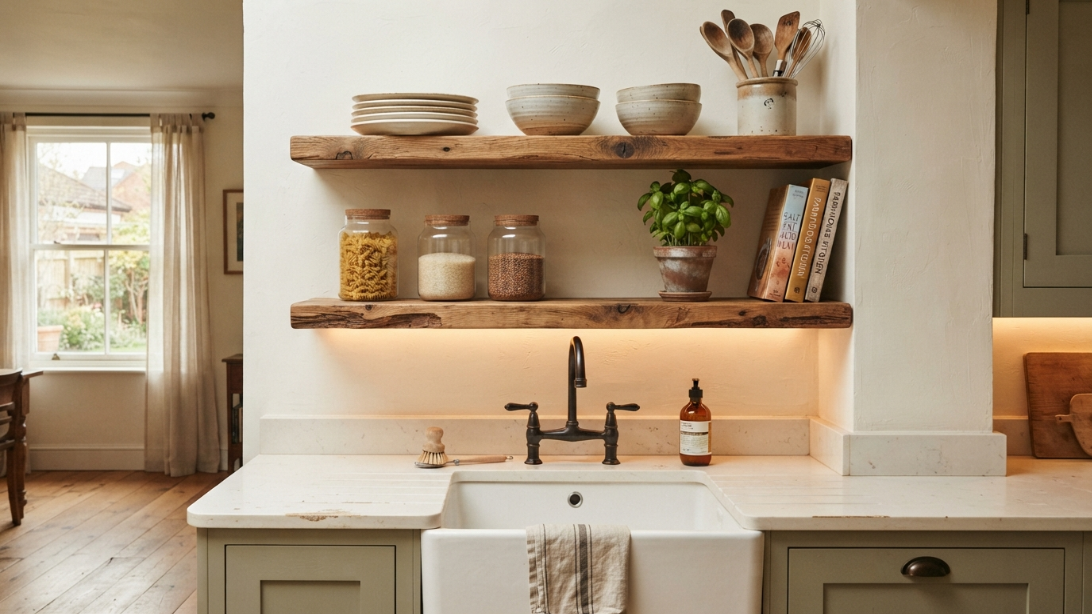
Open shelving in a farmhouse kitchen is not a trend application. It is a return to how kitchens were organized before upper cabinetry became standard in mid-century American kitchen design, and in a farmhouse context it makes immediate practical and aesthetic sense because it makes the kitchen’s contents part of its decoration rather than hiding them behind doors.
Replacing one or two sections of upper cabinets with open shelving rather than removing all upper storage is the practical approach for most kitchens: the open shelving provides the farmhouse visual character and the accessible storage for frequently used items while the remaining closed cabinets handle the less photogenic storage that every kitchen requires. The specific wall section above the sink or beside a window is usually the most visually impactful location for open shelving because it is the most visible area of the kitchen from both the cooking position and the room entry.
Shelf material for farmhouse kitchens should lean toward genuine wood rather than painted MDF or laminate alternatives. Reclaimed wood shelves provide the specific character of aged wood at the cost of sourcing rather than purchasing: salvage yards, architectural salvage shops, and barn lumber dealers often have boards with exactly the right quality of weathered, worn character that freshly milled and artificially distressed wood cannot replicate. Live-edge wood shelves from a local lumber yard or a seller on Etsy provide organic edge variation that adds visual interest and natural character to the wall.
Styling open shelves for authentic farmhouse character means resisting the temptation to make them look like a prop table and instead arranging them the way someone who cooks daily would actually use them: stacks of white or cream ceramic dishes in various sizes, a collection of clear glass jars holding dry goods, wood-handled utensils in a ceramic crock, a few cookbooks stood upright, and one or two decorative objects in natural materials that earn their shelf space through beauty or sentimental value rather than pure decoration.
Top Farmhouse Kitchen Decor Ideas for Rustic Charm Through Hardware and Fixtures
Hardware in a kitchen is the jewelry equivalent of the space: small individually but collectively significant in how they read the room’s character, finish, and style intention.
Hardware Finishes That Read as Genuinely Farmhouse
The hardware finish throughout a farmhouse kitchen communicates the room’s character more consistently than almost any other single decision, because it appears on every cabinet and drawer and therefore sets the tone of the room repeatedly across the entire surface area of the cabinetry.
Matte black hardware provides the most graphic and modern interpretation of farmhouse style and suits white cabinetry particularly well through the high contrast it creates. Bar pulls and simple cup pulls in matte black from Rejuvenation, Schoolhouse Electric, and Amazon Basics at $3 to $15 per piece provide clean lines that reference historical simplicity without looking overly antique.
Oil-rubbed bronze provides the warmer, more traditionally farmhouse finish that suits cream, off-white, and warm gray cabinetry better than the cooler white-and-black combination. The dark brown with copper undertones reads as aged and warm in a way that matte black does not, and it suits the aesthetic of a kitchen that has been lived in for years more naturally than a finish that looks perfect when new.
Unlacquered brass is the hardware finish most strongly associated with genuinely old kitchens and the one that most effectively produces the patina effect that rustic charm requires. It starts bright and gradually darkens and varies at contact points over months of handling, producing exactly the kind of honest material aging that farmhouse style celebrates. Rejuvenation and House of Antique Hardware carry unlacquered brass options that begin the patina process immediately.
Light Fixtures That Set the Farmhouse Tone
Lighting fixtures in a farmhouse kitchen function as architectural elements as much as light sources, and the fixture’s visual character contributes to the room’s style more than its specific light output in most daytime and cooking conditions.
Pendants over an island or sink in black metal, aged brass, or industrial-inspired forms provide the most impactful lighting design statement in a farmhouse kitchen. Schoolhouse pendants with a metal shade in black or aged brass, cage-style pendants with exposed Edison bulbs, and enamel-shaded pendants in cream or black all suit farmhouse kitchens authentically. Rejuvenation, Shades of Light, and Wayfair’s farmhouse collection offer appropriate options from $60 to $400 per pendant depending on quality and source.
A vintage or vintage-style chandelier over a kitchen table or island provides the decorative ceiling element that farmhouse kitchens use in place of recessed lighting to distribute both light and visual character throughout the space. A wagon wheel chandelier, a wrought iron multi-arm fixture, or a simple candelabra style in aged metal all work without requiring an antique search, as reproductions from Wayfair, Pottery Barn, and World Market provide comparable visual character at accessible prices.
3. Use Natural Materials Generously and Honestly
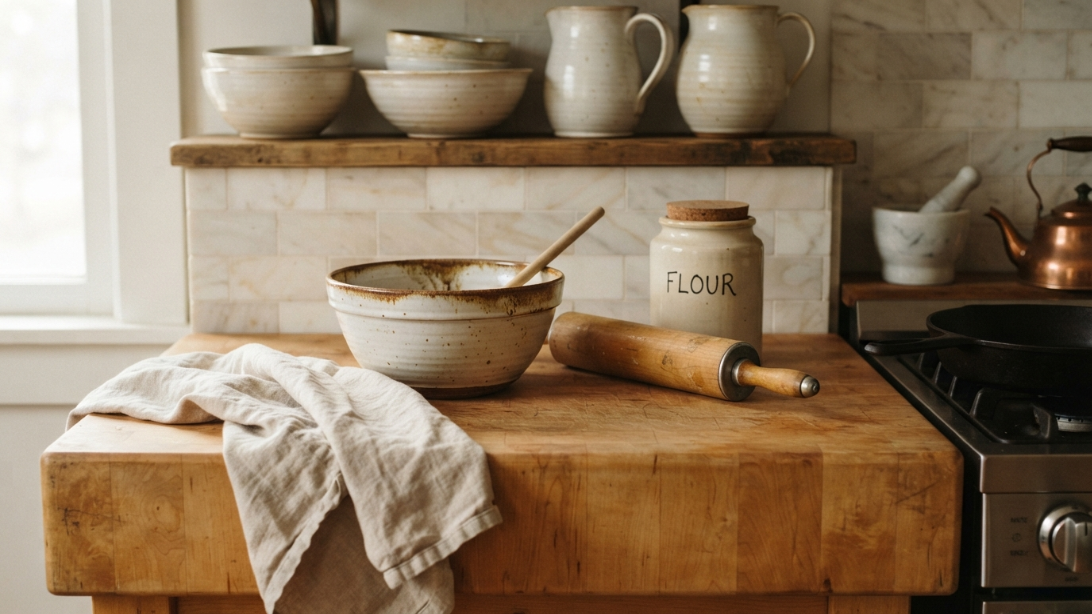
Farmhouse kitchen style’s relationship with natural materials is not decorative. It is foundational: the kitchens that inspired the farmhouse aesthetic used wood, stone, clay, linen, and iron because those were the materials available in a working rural context, and their beauty derived from their fitness for purpose rather than their decorative intent. Using natural materials in a contemporary farmhouse kitchen with this understanding produces more authentic results than using them as stylistic accessories.
Wood countertops or butcher block provide the warmth and working surface character most associated with farmhouse kitchens. A butcher block countertop from IKEA at $200 to $400 for a standard countertop length provides genuine maple or oak in a thickness that looks substantial and ages authentically with use and appropriate oiling maintenance. The scratches, stains, and character marks that develop on a wood countertop over years of use are not failures of the material. They are the honest record of a kitchen that is genuinely used, which is precisely the quality that farmhouse style celebrates.
Natural stone in honed rather than polished finish suits farmhouse kitchens better than its polished equivalent because the matte surface reads as more aged and less manufactured than the high-gloss alternative. Honed marble, soapstone, and honed slate all provide natural stone character with the matte surface that farmhouse aesthetics call for. Soapstone specifically develops a natural patina with mineral oil application that deepens its color and produces the specific aged-stone quality of old farmhouse kitchens.
Ceramic and stoneware in dishware, crocks, vases, and decorative vessels provide the handmade, slightly imperfect quality that factory-produced alternatives cannot replicate. A collection of white or cream ceramic pieces in varying sizes, some with visible throwing lines, rim variations, and glaze inconsistencies, looks more authentically farmhouse than a matched set of perfectly uniform dishes from a mass-market retailer.
4. Incorporate a Farmhouse Table as the Kitchen’s Social Center
The farmhouse kitchen table is the room’s social and functional center in a way that more contemporary kitchen islands partially replicate but never fully replace, because the table’s association with gathering, shared meals, and extended conversation gives it a warmth that a kitchen work surface, however beautiful, does not naturally carry.
A solid wood farmhouse table with a top thick enough to look substantial, at least one and a half inches, and legs simple enough to read as honest rather than decorative, provides the visual and functional anchor that a farmhouse kitchen dining area requires. Reclaimed wood tables from local artisans found through Etsy or local markets at $600 to $1,500 provide the material character of genuinely aged wood. West Elm, Pottery Barn, and IKEA’s MÖRBYLÅNGA line at $400 to $800 provide accessible solid wood options with appropriate proportions.
Mismatched chairs around a farmhouse table provide more authentic visual character than a matched dining set, because they suggest a table that has been surrounded by chairs acquired at different times rather than purchased as a coordinated set. A combination of wood chairs in similar tones but slightly different profiles, one or two upholstered chairs in a durable linen or canvas fabric, and perhaps a simple bench on one side produces the gathered, accumulated quality that farmhouse aesthetics celebrate.
Table styling for a farmhouse kitchen should feel like a table that is used daily rather than styled for display: a simple linen runner rather than a formal tablecloth, a ceramic pitcher holding wildflowers or herb stems, a wooden bowl containing seasonal fruit, and a small candle or oil lamp in the center provide the composed but functional quality that suits the farmhouse aesthetic better than elaborate centerpiece arrangements.
5. Display Functional Objects as Decoration
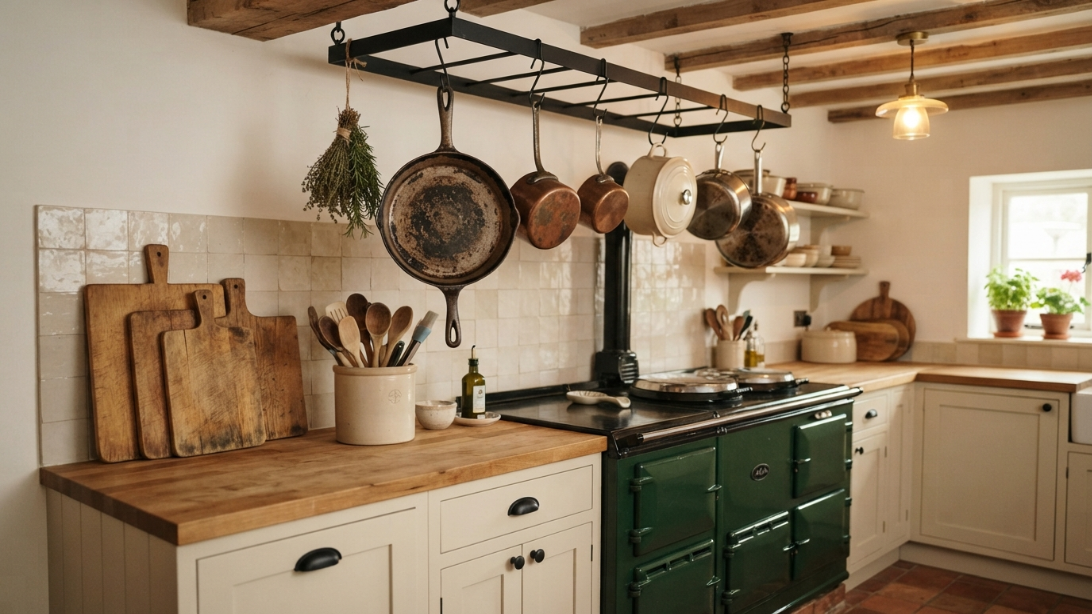
The farmhouse kitchen’s approach to decoration is fundamentally different from other kitchen styles in that it treats functional objects, pots, pans, utensils, produce, jars, and cutting boards, as decoration rather than maintaining a strict separation between the kitchen’s working tools and its decorative elements. This approach reflects the practical reality of a working kitchen and produces a more genuinely authentic farmhouse character than decorative objects that serve no function alongside purely functional ones that are hidden from view.
Hanging pot racks display the kitchen’s cookware as both functional storage and visual element. A ceiling-mounted pot rack in black iron or aged steel above the island or range provides the dramatic farmhouse statement of displayed cookware while genuinely solving a storage problem. Wall-mounted pot racks beside the range provide the same function in a less spatially demanding format. The cookware displayed should be genuinely beautiful: cast iron skillets, copper pots, and enameled Dutch ovens in cream or red contribute to the display quality in ways that non-stick aluminum pans do not.
A utensil crock or ceramic jar beside the range holding wooden spoons, spatulas, whisks, and tongs displays the kitchen’s working tools in a way that is immediately practical and visually warm. A handmade stoneware crock from an Etsy ceramicist at $30 to $60 or a repurposed antique crock from a thrift store at $5 to $20 provides the farmhouse-appropriate vessel in which these tools look genuinely displayed rather than merely stored.
Wooden cutting boards of varying sizes leaned against the backsplash or displayed on the counter serve as both working surfaces and visual elements. A collection of boards in varying wood tones, some with handles and some without, some with visible knife marks that record their working history, contributes the honest material character that farmhouse kitchens display without self-consciousness.
6. Add Vintage and Antique Elements Selectively
Nothing produces farmhouse character more efficiently than genuine age, and incorporating antique and vintage elements into a contemporary farmhouse kitchen provides the specific quality of accumulated character that even the most skilled contemporary reproduction cannot fully replicate.
Antique kitchen tools displayed on open shelves, hung from hooks, or used as functional objects bring historical authenticity to a farmhouse kitchen at costs that vintage markets, estate sales, and antique shops make very accessible. A collection of vintage tin canisters holding dry goods, an antique wooden rolling pin displayed on open shelving, old enamelware pieces in white with blue or red trim, and cast iron pieces with decades of seasoning all contribute genuine age to the kitchen’s material palette.
Vintage scales, clocks, and signs in the farmhouse kitchen provide the specific quality of objects that existed before design became a self-conscious practice, when things were made to work well and happened to look good as a consequence. A vintage postal scale or kitchen scale in cast iron or enamel on the counter, an antique clock on the wall, and a market sign or typographic print in aged wood or metal all contribute this quality at costs typically between $10 and $80 from eBay, Etsy, and local antique markets.
Repurposed and upcycled elements that bring previous lives into the kitchen add the layered history that farmhouse style celebrates: a window frame repurposed as a pot rack, a ladder used as a pot and pan display, a vintage bread box that functions as contemporary storage, and antique hardware on new cabinetry all introduce genuine age into a kitchen that might otherwise feel too new to be convincingly farmhouse.
7. Use Plants and Fresh Produce as Living Decoration
A farmhouse kitchen in active use has plants and fresh food as visual elements alongside its decorative ones, because the agricultural context of the farmhouse aesthetic makes growing and harvesting things a natural expression of the kitchen’s identity rather than a decorative choice that requires justification.
Herb gardens on the windowsill provide both fresh herbs for cooking and the living green element that a farmhouse kitchen benefits from visually. A row of terracotta pots in graduating sizes on the windowsill holding basil, rosemary, thyme, mint, and chives looks both beautiful and genuinely useful in a way that purely decorative plants do not. The terracotta pots specifically suit farmhouse kitchens because their natural clay color and the white salt deposits that develop on their exterior over time read as honest, aged, and organically connected to the garden.
A bowl of seasonal fruit or vegetables on the counter or table provides the color, organic texture, and seasonal connection that a farmhouse kitchen should maintain as a living connection to the agricultural world its style references. A wooden dough bowl or ceramic colander holding lemons, apples, or a mix of seasonal produce costs nothing beyond the produce itself and provides a visual element that looks more appropriate in a farmhouse kitchen than any comparable decorative object.
Dried botanicals and herbs hanging from hooks or displayed in ceramic vessels extend the plant presence into the visual palette without the maintenance requirements of living plants. Bundles of dried lavender, dried wheat stems, eucalyptus, and dried herb bunches hung from a ceiling-mounted rack or displayed in a ceramic vase add the organic texture and muted color of dried plant material that suits farmhouse kitchens authentically.
8. Bring in Textiles That Work as Hard as They Look
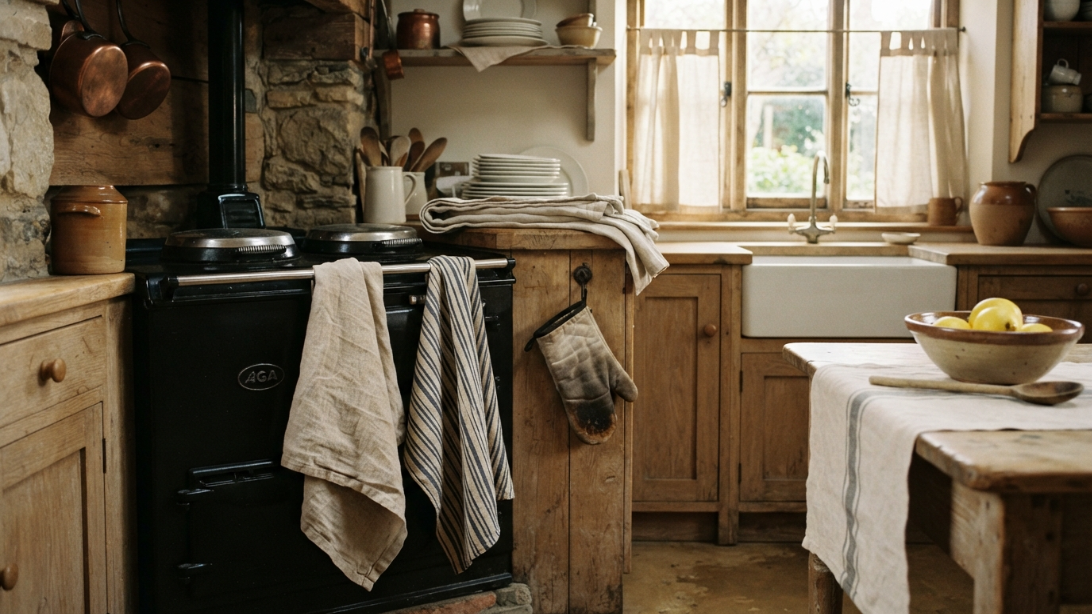
Textiles in a farmhouse kitchen serve primarily functional purposes, drying dishes, protecting hands, covering food, and cushioning bar stools, and the farmhouse approach treats these functional textiles as decorative elements rather than hiding them in drawers and replacing them with purely decorative ones.
Linen dish towels hung from the oven handle, draped over the sink edge, or folded on the open shelf provide the texture, casual arrangement, and natural material warmth that farmhouse kitchens require. Linen dish towels from Cultiver, Fog Linen, and Etsy artisans at $12 to $25 each in natural, undyed linen or simple stripe patterns suit farmhouse kitchens specifically because linen’s slightly rough texture, natural color variation, and graceful aging with washing all read as authentic rather than decorative.
A grain sack or stripe pattern on textiles throughout the kitchen, in a table runner, curtain panels, seat cushions, and dish towels, provides the graphic simplicity and historical reference that suits farmhouse style without requiring elaborate coordination. IKEA HJARTSTILLA textiles, Pottery Barn’s grain sack collection, and Etsy shops specializing in reproduction grain sack fabric all provide this pattern at accessible prices.
Curtain panels in simple linen or cotton on kitchen windows provide privacy when needed and a soft, natural material frame for the window that suits farmhouse kitchens better than wood blinds or synthetic curtains. Simple tab-top linen panels in natural or off-white, hung from simple iron rods with ring clips, provide the maximum farmhouse character at the minimum cost and complication.
FAQs
What are the most impactful top farmhouse kitchen decor ideas for rustic charm on a small budget?
Hardware replacement is the highest-impact lowest-cost farmhouse kitchen update available: replacing existing cabinet hardware with matte black, oil-rubbed bronze, or unlacquered brass alternatives costs $50 to $150 for a full kitchen and immediately shifts the room’s character. Adding open shelving in one section, a linen dish towel collection, a ceramic utensil crock, and a windowsill herb garden collectively costs under $100 and provides the layered, functional, and natural material quality that farmhouse kitchens require.
Can I achieve farmhouse kitchen style without replacing cabinets?
Completely. Paint existing cabinets in a warm white, cream, or soft sage, replace the hardware, add open shelving in one or two sections by removing upper cabinet doors, and style the open shelves with white ceramic and natural wood objects. These four changes transform the kitchen’s character without touching the cabinet boxes themselves and cost a fraction of cabinet replacement.
What colors work best for farmhouse kitchen walls?
Warm white, cream, soft sage, dusty blue, and warm gray all suit farmhouse kitchens authentically. The specific quality these colors share is warmth and slight mutedness rather than brightness and saturation. Benjamin Moore White Dove, Sherwin-Williams Accessible Beige, Farrow and Ball Mizzle, and Benjamin Moore Pale Oak are consistently recommended farmhouse kitchen wall colors that suit the aesthetic’s warmth requirements without reading as trendy.
Is shiplap necessary for a farmhouse kitchen?
No, and overusing shiplap is one of the fastest ways to make a farmhouse kitchen look styled rather than genuine. Shiplap on one wall or as a specific architectural accent contributes farmhouse character without dominating the room. Natural plaster walls, simple painted drywall with good texture, beadboard lower walls with open shelving above, and brick or stone backsplashes all provide authentic farmhouse character without requiring shiplap.
How do I make a modern kitchen feel more farmhouse without a renovation?
Focus on the elements that are movable and replaceable: hardware, textiles, displayed objects, lighting fixtures, and open shelving additions. Add a farmhouse table to the eating area, replace pendant lights with farmhouse-appropriate fixtures, display wooden cutting boards and ceramic crocks on the counters, add a windowsill herb garden, and hang linen dish towels from the oven handle. These changes require no structural work and collectively shift the kitchen’s character significantly toward farmhouse warmth.
Conclusion
A farmhouse kitchen that feels genuinely warm and characterful is not the result of purchasing the right collection of farmhouse-labeled objects. It is the result of understanding that farmhouse style is about honest materials, functional display, accumulated character, and the specific warmth of a room that works hard and is loved for it. Start with the hardware, add the natural materials, display what you use, and let the room develop its character over time rather than arriving at it all at once. Which element of your kitchen are you changing first?