
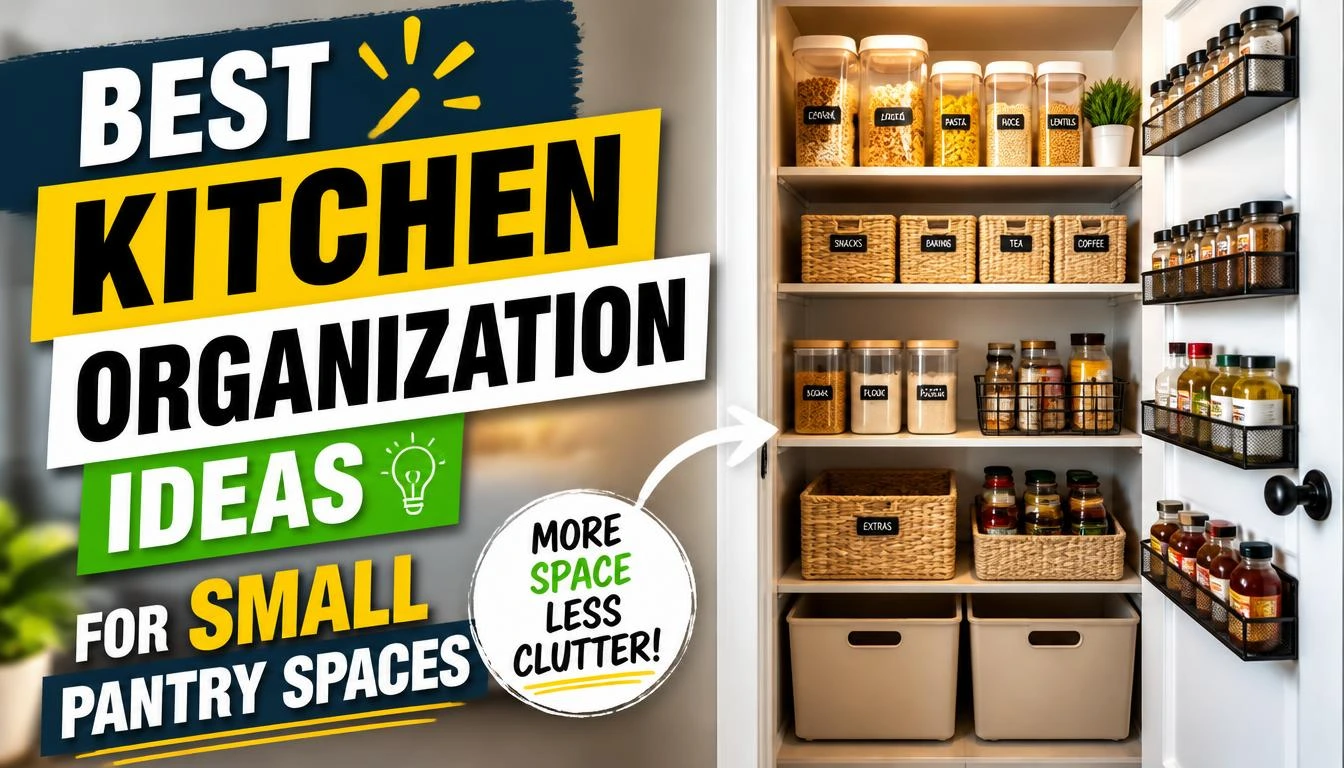
The best kitchen organization ideas for small pantry spaces are not the ones that require you to buy forty matching containers, label everything with a Cricut machine, and reorganize your entire kitchen over a weekend while somehow feeling joyful about it. Real pantry organization for small spaces is about making the space easier to use every single day, finding things without moving six other things first, and keeping it that way without daily maintenance that nobody has time for. If your pantry is a cabinet, a small closet, a few shelves, or even just a corner of your kitchen, these ideas work.
Why Small Pantry Spaces Always Feel Chaotic
Small pantry spaces feel chaotic for one consistent reason. The space was never properly set up to hold what it’s being asked to hold. Things get shoved in wherever they fit, categories mix together, taller items block shorter ones, and within two weeks of any organizing attempt the whole system collapses back into its previous state.
The problem is almost never the size of the space. It is almost always the absence of a system that works with how the space actually functions rather than how an organizing influencer’s pantry functions. Real organization accounts for real life, which means imperfect weekly restock habits, different household members with different putting-away instincts, and the reality that sometimes groceries get unloaded fast and chaotically.
1. Empty Everything Out First Before Buying a Single Organizer
This is the step that most people skip because it is the least satisfying step, and it is the one that makes every subsequent step work better. You cannot organize what you have not fully seen.
Pull everything out of the pantry completely. Check expiration dates and discard anything past its date. Group similar items together on the counter so you can see exactly what categories of food you actually own. Notice what you have multiples of because you kept buying it thinking you were out. Notice what you never use. Notice what takes up the most space. This inventory completely changes what organizing solutions you actually need versus what looks good in a before-and-after photo. Knowing what you have is the foundation every organization system has to be built on.
2. Categorize Before You Organize
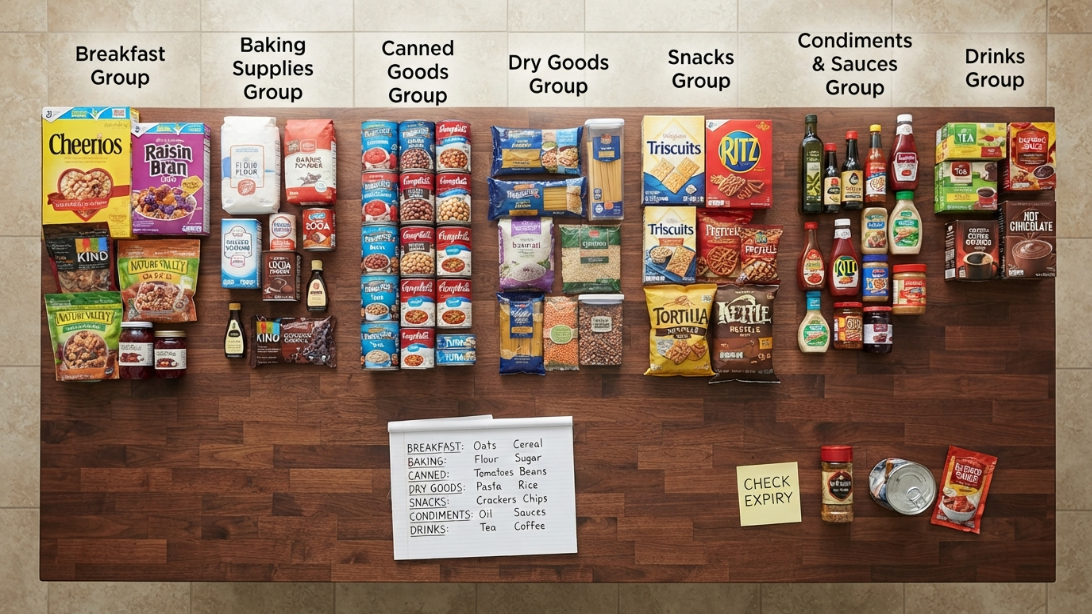
Once everything is out and visible, grouping items into categories before putting anything back produces a more logical and more sustainable organization system than trying to find homes for individual items one at a time.
Common pantry categories include breakfast items, baking supplies, canned goods, dry goods like pasta and rice, snacks, condiments, cooking oils and vinegars, drinks and powders, and kids food if applicable. Your specific household categories might look different and that is fine. The point is defining categories that reflect how you actually cook and shop rather than generic pantry categories that look good on a label. Categories that match your actual habits are the ones that get maintained.
3. Use the Zones System for Daily Logic
Once categories are defined, organizing them into zones based on frequency of use makes the pantry significantly more functional in daily life. The things you reach for every day should be the easiest to access. The things you use occasionally can live in less convenient spots.
Eye-level shelves are prime real estate in any pantry. That zone should hold daily-use items, snacks, breakfast foods, and anything you grab without thinking. Upper shelves work for bulk backup items, rarely used baking supplies, and large items bought in quantity. Lower shelves handle heavy items like canned goods, large bottles, and bulk bags that are stable and easy to grab from below. Zone logic makes the pantry faster to use and easier to maintain because everything has a location that makes instinctive sense.
4. Add Shelf Risers to Double Your Shelf Capacity
Shelf risers are one of the highest-impact and lowest-cost organization tools available for small pantry spaces. They sit on an existing shelf and create two levels of storage where there was previously one, effectively doubling the useful capacity of that shelf without any installation or permanent changes.
Tiered spice risers at the back of a shelf let you see every spice without lifting the front row. Stepped can risers display canned goods so labels face forward and nothing gets buried behind anything else. Bamboo or acrylic shelf risers in different heights work for grouping and separating categories within a single shelf. Vertical space within a shelf is almost always underused in small pantries, and risers fix that immediately.
5. Use Clear Containers for Dry Goods, But Only When It Makes Sense
Clear containers for dry goods look beautiful, help you see quantities at a glance, and keep things fresher than open bags left to roll closed with a rubber band. They are also an investment that makes sense for things you use regularly and refill consistently.
The mistake people make is buying a full set of identical containers for every dry good they own, including the items they use occasionally and the items that come in packaging designed to keep them fresh already. Prioritize clear containers for things you use daily or weekly, specifically flour, sugar, rice, pasta, oats, coffee, and snacks that come in awkward bags. Leave specialty items in their original packaging. Strategic containerizing saves money and avoids the container chaos that happens when you buy more than the space can hold.
6. Install a Door Organizer on the Pantry Door
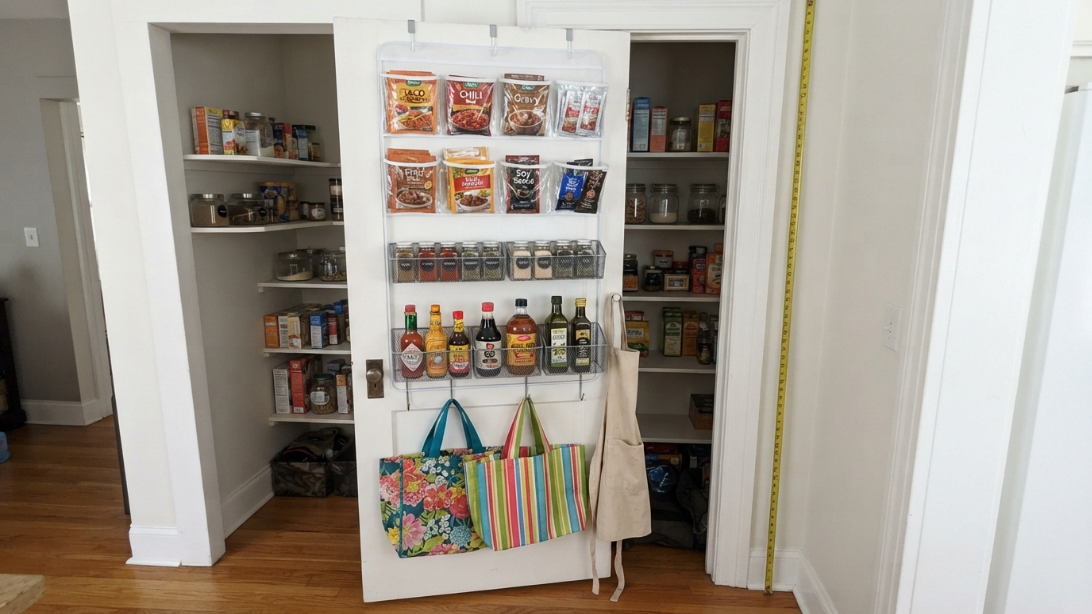
The back of a pantry door is one of the most consistently wasted surfaces in a kitchen. An over-door organizer mounted on the pantry door can hold a remarkable amount of additional storage without taking up any shelf space at all.
Over-door organizers with clear pockets work well for spice packets, seasoning mixes, small snack bags, and items you want to see quickly. Wire rack door organizers with deeper bins hold bottles, cans, and boxed items. A simple row of hooks on the door can hold aprons, reusable bags, or measuring tools. Door space is free real estate that most small pantries never use.
7. Group Canned Goods in Baskets or Bins by Category
Loose canned goods on a shelf create the specific pantry chaos where you pull out four cans looking for one and nothing ever stays organized for more than a day. Grouping canned goods in shallow bins or baskets by category solves this completely.
One bin for tomato products, one for beans, one for soups, one for proteins like tuna and chicken. When you need a can of tomatoes you pull out the tomato bin, take what you need, and slide it back. The rest of the shelf stays undisturbed. Clear bins let you see what you have without pulling everything forward. Wire bins allow air circulation. Bin grouping makes canned goods the most organized category in any pantry with almost no ongoing effort.
8. Use a Lazy Susan for Oils, Vinegars, and Sauces
Bottles and jars at the back of a pantry shelf are impossible to access without moving everything in front of them, which is why they tend to stay at the back forgotten until you move house and discover twelve half-used bottles of soy sauce.
A lazy Susan on a pantry shelf solves this completely. Spin it to bring what you need to the front. Group oils together, vinegars together, and Asian sauces together on the same lazy Susan or on separate ones depending on your space. Lazy Susans work equally well in corner cabinet spaces, on shelves, and inside large pantry closets. Rotation access eliminates the lost-at-the-back-of-the-shelf problem permanently.
9. Label Everything, But Make It Simple
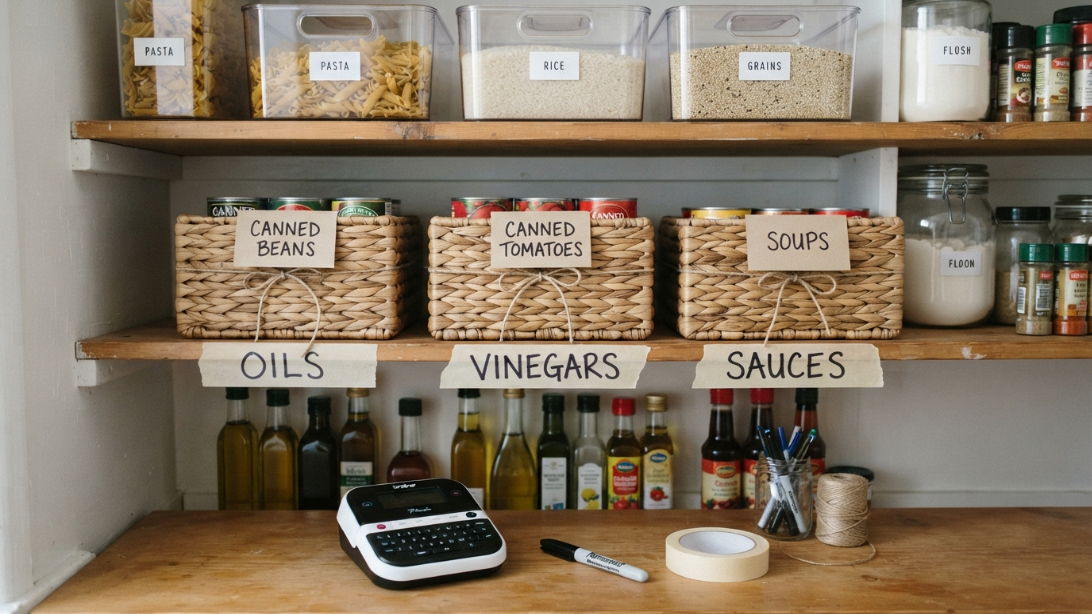
Labels help everyone in the household know where things go, which is the specific problem that makes organization systems fail after one week. When nobody is sure where the quinoa lives or whether the almonds go in the nut bin or the snack bin, everything ends up wherever it landed when the groceries were put away.
Labels do not need to be beautiful or Cricut-made to work. A label maker, masking tape and a marker, or printed paper labels all communicate the same information equally effectively. Label bins, baskets, containers, and shelf zones rather than every individual item. Clear labeling is the difference between a system one person maintains and a system the whole household maintains.
10. Create a Snack Zone That Anyone Can Navigate
If you have children or multiple household members who access the pantry independently, a dedicated snack zone that is easy to see and reach is one of the most practically useful small pantry organization ideas available.
A clear bin at eye level for children or at lower shelf height for kids filled with pre-approved snacks lets everyone serve themselves without disrupting the rest of the pantry organization. Keeping the snack zone stocked and straightforward means fewer questions, fewer pantry raids that leave things in the wrong place, and fewer situations where someone leaves an open bag of chips balanced on top of the pasta boxes. Household accessibility makes organization sustainable in shared living situations.
11. Use Stackable Bins for Deep Pantry Shelves
Deep shelves in a pantry are both a gift and a problem. The gift is volume. The problem is that things at the back become effectively invisible and therefore functionally nonexistent. Stackable bins that can be pulled out like drawers solve this better than any other solution for deep shelf pantries.
Pull-out drawer organizers that sit on the shelf and slide forward give you access to everything in the bin without removing the bin itself. Stackable clear bins that lift off each other let you access layers of storage without unpacking the whole shelf. Pull-out access makes deep shelves as functional as shallow ones.
12. Handle Baking Supplies as Their Own System
Baking supplies are the pantry category that most consistently creates chaos because they include items in wildly different formats, from small spice jars to large bags of flour to specialty ingredients used once and then forgotten for eight months.
Keep all baking supplies together in one dedicated zone and subdivide with smaller containers and bins within that zone. A large airtight container for flour, another for sugar, a small bin for leavening agents and spices used only for baking, and a basket for chocolate chips and other mix-ins keeps the category contained. Category containment prevents baking supplies from spreading across every shelf and creating category confusion throughout the pantry.
13. Store Bulk Items in Decanted Containers Outside the Pantry
Bulk purchases are economical but terrible for small pantry organization because their packaging is oversized, irregular, and takes up premium shelf space that more frequently used items need.
Decant bulk dry goods into large airtight containers and store the overflow outside the pantry in a separate storage area. A large food-safe bucket for bulk flour, a big jar for bulk oats, and a large container for bulk rice can live in a garage, basement, or under-bed storage and be refilled into smaller pantry containers as needed. Overflow storage outside the pantry keeps the pantry itself manageable without giving up the cost benefits of buying in bulk.
14. Add Extra Shelving if the Space Allows Any Adjustment
Many pantry spaces have fixed shelf positions that were installed for aesthetics rather than practical storage logic. Large gaps between shelves that could hold two levels of storage hold only one because nobody ever adjusted them.
Check whether your pantry shelves are adjustable. If they are, reorganize the shelf heights to match the actual items being stored rather than keeping whatever spacing came default. If shelves are fixed but wall space exists, floating shelves installed between existing shelves or above the existing top shelf add storage without major modification. Shelf adjustment is free additional storage that is already in the space waiting to be used.
15. Maintain the System With a Weekly Five Minute Reset
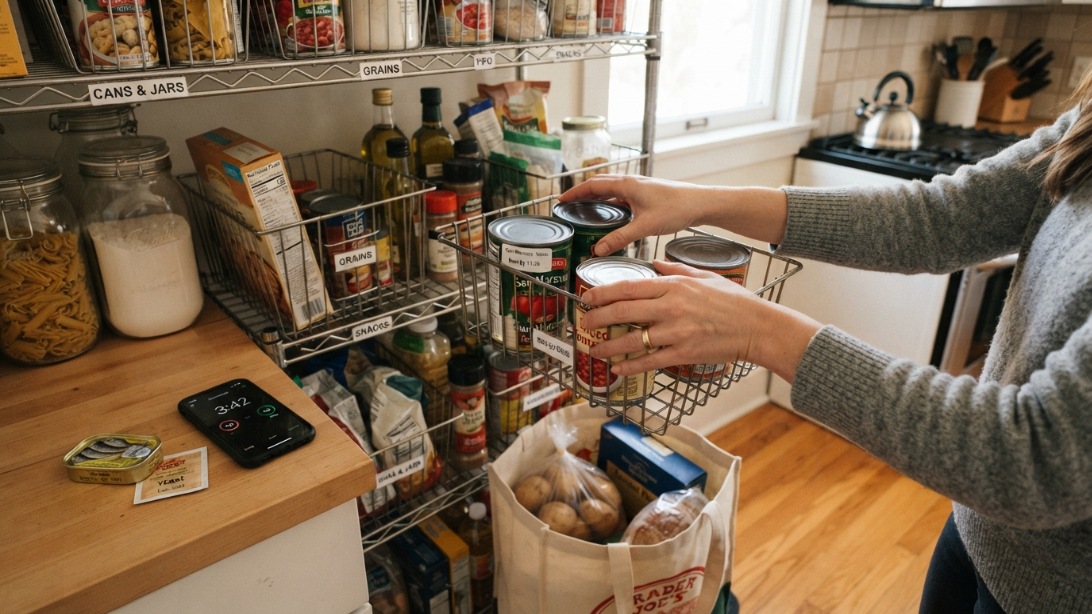
The most perfectly organized pantry in the world falls apart within a month without any maintenance system. But maintenance does not need to be a major undertaking. A five minute weekly reset is enough to keep a well-organized small pantry functional indefinitely.
Every grocery delivery or shop day, put new items at the back and pull older items forward before putting anything away. This first-in-first-out rotation takes thirty extra seconds per category and eliminates expired food waste almost entirely. Once a week, spend five minutes returning any misplaced items to their correct zones and straightening bins that have been disrupted. Minimal maintenance done consistently beats major reorganization done occasionally every time.
FAQs
What are the best storage containers for a small pantry?
OXO Good Grips, Rubbermaid Brilliance, and IKEA 365 containers all offer good quality airtight storage at different price points. For bins and baskets, clear acrylic bins from The Container Store, wire baskets from IKEA, and woven seagrass baskets from Target all work well. The best containers are the ones sized correctly for what you are storing and your specific shelf dimensions, so measure before buying anything.
How do I organize a pantry that is just one cabinet?
Treat the cabinet exactly like a full pantry but scaled down. Use the door for small items with an over-door organizer. Use shelf risers to create levels within shelves. Group categories in small bins. Put daily use items at eye level and less used items above and below. A single cabinet can hold a surprising amount when the vertical space within each shelf is properly used.
How do I keep my pantry organized when I have a busy household?
Make the system simple enough that anyone can follow it without instruction. Use clear bins and labels so the correct home for every item is immediately obvious. Create a snack zone that household members can access without disrupting other categories. Accept that perfect organization is less important than functional organization and build in a weekly reset that takes less time than finding things in a chaotic pantry.
Is it worth buying matching containers for pantry organization?
Matching containers make the pantry look better and make it easier to use because uniform sizes stack and fit shelves more efficiently than mixed packaging. But buying a full matching set immediately is not necessary. Start with the categories you use most and add matching containers gradually. Generic clear containers from discount stores work as well functionally as expensive branded sets.
Conclusion
The best kitchen organization ideas for small pantry spaces come down to using what you have more intelligently rather than buying more things to put in an already tight space. Empty it out, categorize what you actually own, assign logical zones, add a few targeted solutions for the biggest problems, and maintain it with a habit rather than a weekend project. Which part of your pantry is causing the most daily frustration right now, and which of these ideas would fix it fastest?