

The top cozy living room decor ideas for winter season are not about buying an entirely new set of decorative objects every November and storing them in labeled plastic bins until the following October. They are about understanding what makes a room feel genuinely warm and inviting rather than merely styled, and then making targeted changes that cost relatively little but shift the entire atmosphere of a space in ways that matter more on a cold January evening than any other time of year. I have lived in apartments that felt cold regardless of the thermostat setting and in rooms that felt warm even when the heating was imperfect, and the difference between them was almost entirely about texture, light, and layering rather than square footage or expensive furniture.
Understanding What Actually Makes a Room Feel Cozy
The feeling of coziness in a room has a name in Danish and Norwegian design culture: hygge, pronounced roughly as hoo-gah, which describes the quality of warmth, comfort, and convivial intimacy that a well-arranged space produces. The concept has been commercially exploited to the point of meaninglessness in some contexts, but the underlying design principles it points toward are genuinely useful for understanding why some rooms feel immediately welcoming and others do not.
Warmth in the visual spectrum is the first principle. Rooms that feel cold visually use cool color temperatures in lighting, blue and grey tones in textiles and walls, and hard reflective surfaces that bounce light in ways that register as bright and energetic rather than warm and restful. Rooms that feel warm visually use amber-toned lighting, warm neutrals and earthy colors in textiles and soft furnishings, and matte and textured surfaces that absorb and soften light rather than reflecting it sharply. This visual warmth registers in the brain as physical warmth through a well-documented neurological association between warm color temperatures and thermal comfort.
Scale and proportion relative to the body is the second principle. Furniture and arrangements that feel cozy are typically scaled to bring people into close proximity with each other and with the walls and objects surrounding them, creating a sense of containment that the brain reads as shelter. A small room with good proportioning feels cozier than a large room with furniture arranged to emphasize its size, which is why the instinct to push all furniture against the walls to make a room look bigger is the specific arrangement decision that makes rooms feel simultaneously spacious and somehow cold and unwelcoming.
Sensory layering is the third principle and the one most directly actionable through decorative choices. Rooms that feel cozy engage multiple senses simultaneously: textiles that look soft and feel soft when touched, lighting that looks warm and creates shadows that make a room feel dimensional rather than uniformly illuminated, scent from candles or natural sources that register before visual analysis begins, and sound management through textiles and soft surfaces that absorb the echoes that make empty rooms feel cold and hollow.
1. Layer Textiles in Three Dimensions
The most immediate and highest-impact change available to anyone making a living room cozier for winter is adding textiles in three dimensions: horizontal surfaces including sofas, chairs, and floors, vertical surfaces including walls and windows, and suspended and hanging elements.
A sofa that has one decorative pillow and one thin blanket reads as a sitting surface. The same sofa with four to five pillows in varying sizes and textures, two different weight throws arranged casually rather than folded precisely, and a slightly different-toned cushion arrangement than the summer version reads as an invitation to settle in rather than a place to briefly sit. The specific textiles that contribute most to winter coziness are those with high tactile warmth: chunky knit throws in natural wool or wool-blend yarns, velvet and velvet-adjacent pillows that feel noticeably warmer than linen or cotton alternatives, faux fur accent pieces used selectively rather than comprehensively, and Sherpa and fleece elements that are soft enough to visually communicate warmth before being touched.
Layering rather than matching is the textile principle that produces the rich, collected feeling of a genuinely cozy room rather than the coordinated but flat feeling of a styled one. A sofa with three pillows in the same fabric looks coordinated. The same sofa with pillows in three related but different textures, one velvet, one knit, one woven, in tones from the same warm color family looks layered and lived-in in a way that produces a stronger coziness signal. The throw that is casually draped over one arm rather than folded symmetrically looks more genuinely inviting than its identical twin folded to equal thirds and placed on both arms.
2. Rethink Your Lighting Completely
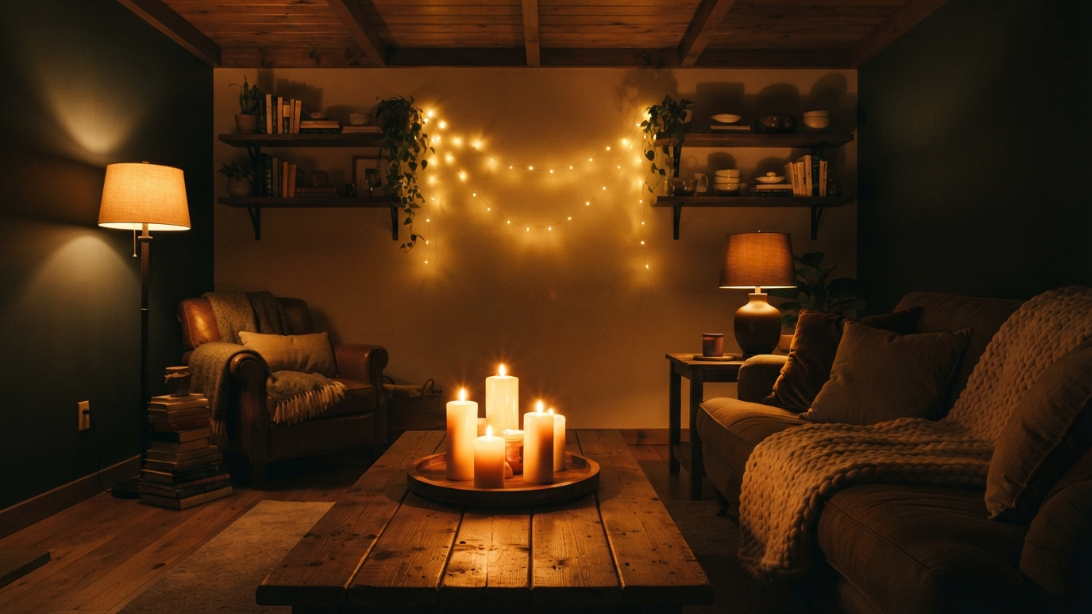
Overhead lighting is the enemy of a cozy living room in winter, and understanding why makes the solution obvious. Overhead light sources illuminate a room from above and behind the human field of vision, producing the same quality of light as the overcast daylight that winter provides in abundance. The brain does not register overhead lighting as warmth or shelter because daylight comes from above, and a brightly overhead-lit room triggers the same alertness associations as outdoor daytime.
Candlelight and firelight produce warmth-associated coziness because they originate at or below eye level, cast upward shadows, and produce the amber color temperature that the brain associates with the warmth of fire. The most effective winter lighting strategy for a living room replaces overhead lighting as the primary light source with a combination of table lamps, floor lamps, string lights, and candles that collectively produce enough light to navigate and read by while creating the layered shadow and warm-tone illumination that the hygge principle requires.
Candles specifically deserve attention beyond their role as fragrance delivery mechanisms. A grouping of three to five candles of varying heights on a coffee table, arranged on a simple tray or wooden board, produces the specific amber flicker that no electric source fully replicates. Battery-powered flameless candles from brands like Luminara at $30 to $60 each produce a realistic flicker effect that is appropriate for households with children or pets where open flames are impractical. String lights used inside rather than saved exclusively for outdoor and holiday use provide ambient light with a warm tone that fills the spaces between larger light sources without adding overhead brightness.
Dimmer switches installed on existing overhead fixtures allow the overhead light to serve as a functional layer when needed and be reduced to a warm, low glow during evening hours when coziness is the priority rather than visibility. A dimmer switch installation costs $15 to $30 in hardware and thirty minutes of work, and the quality-of-light improvement it provides for the cost ranks among the highest-return home improvement investments available in the lighting category.
Top Cozy Living Room Decor Ideas for Winter Season: Textural Elements
Texture in a living room performs a function that is partly visual and partly psychological: textured surfaces suggest physical warmth and softness even before being touched, because the brain recognizes textural complexity as a marker of the natural materials, wool, wood, stone, and clay, that have historically provided warmth and shelter.
Area Rugs as the Foundation
A living room without a rug in winter feels categorically different from the same room with one, regardless of whether the floor is wood, tile, or carpet. The rug provides both literal insulation from a cold floor and visual warmth through its color, pattern, and texture that changes the entire atmosphere of the space it occupies.
Wool rugs provide the most genuinely warm tactile experience of any rug material and have the additional advantage of being naturally fire-resistant, which matters in rooms where candles are used. Jute and sisal rugs provide natural texture but no thermal insulation and are better suited as layering pieces under a warmer textile than as the primary floor covering in a cold room. Shaggy and high-pile rugs provide the maximum visual and tactile warmth signal of any rug format, particularly in cream, ivory, and warm grey tones that read as soft and inviting rather than practical.
Rug layering, placing a smaller decorative rug over a larger area rug, is the interior design technique that produces the richest floor treatment available for a budget-conscious approach to cozy room styling. A standard jute area rug that costs $80 to $150 at IKEA or Ruggable serves as the base layer, and a smaller, more textured or patterned rug placed at an angle over it adds depth and visual warmth at lower cost than replacing the base rug with a more expensive option.
Curtains and Window Treatments for Winter
Windows are the primary source of heat loss and cold draft in most rooms, and curtains that address this functionally while contributing to the visual warmth of the space perform double duty that makes them one of the highest-value decorating decisions for winter specifically.
Thermal-lined curtains provide genuine insulation by trapping an air layer between the window glass and the room interior. Velvet curtains provide the maximum combination of visual warmth, sound absorption, draft exclusion, and light control of any curtain fabric. A pair of floor-to-ceiling velvet curtains in a warm emerald green, deep burgundy, navy, or warm terracotta frames a window in the way that heavy drapes in historic houses created the sense of warmth and shelter that modern minimal window treatments sacrifice for light and sight lines. Hang curtains as high as possible and as wide as possible beyond the actual window frame: curtains hung from ceiling height rather than window height make ceilings appear taller, windows appear larger, and the room appear more generously proportioned while also providing more complete draft exclusion at the window edges.
3. Create a Focal Point With a Fireplace or Alternative
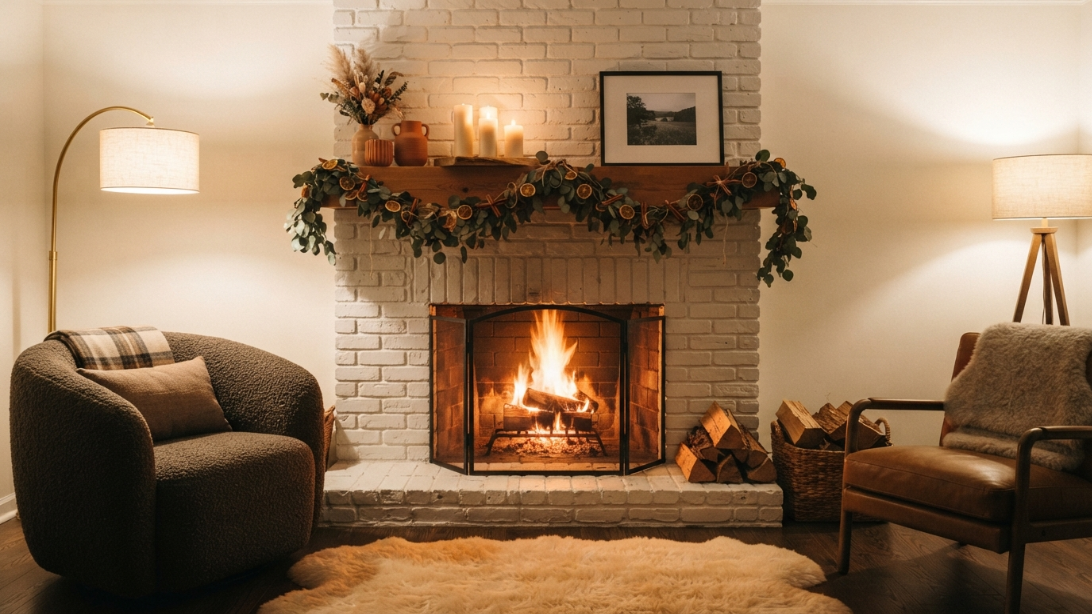
A fireplace is the most powerful single element a living room can contain for creating genuine winter coziness, and its effectiveness is more psychological than thermal because the visual of a contained flame triggers deeply wired associations with warmth and safety that no other room element replicates. If a wood-burning or gas fireplace exists in the room, making it the functional and decorative center of the winter living room arrangement through furniture positioning and mantel styling is the highest-return single decorating decision available.
For rooms without a fireplace, the alternatives range in effectiveness and cost. Electric fireplaces with realistic flame simulation technology have improved significantly: units from Dimplex and Napoleon at $400 to $1,200 produce flame effects sufficiently realistic to register the psychological warmth response in the absence of actual fire. Wall-mounted electric fireplaces at $200 to $500 from brands including ClassicFlame and R.W. Flame provide the visual element at a lower price point without the heat output of higher-end units. A simple candle arrangement in front of a mirror that reflects and multiplies the flame achieves a fireplace-adjacent visual effect at the cost of the candles and a well-positioned mirror.
Mantel styling for winter deserves specific attention because the mantel surface is the room’s primary decorative focal point when a fireplace is present, and its styling signals the seasonal character of the room more directly than any other single surface. A winter mantel arrangement might include a garland of preserved eucalyptus, a grouping of pillar candles at varying heights, framed photographs or artwork, natural elements including pine cones, bare branches, or dried botanicals, and one or two ceramic or metallic objects in warm tones. The principle is that a mantel should look collected over time rather than purchased as a complete set, which means mixing materials, heights, and origins rather than displaying matching decorative objects from the same collection.
4. Bring Natural Elements Indoors
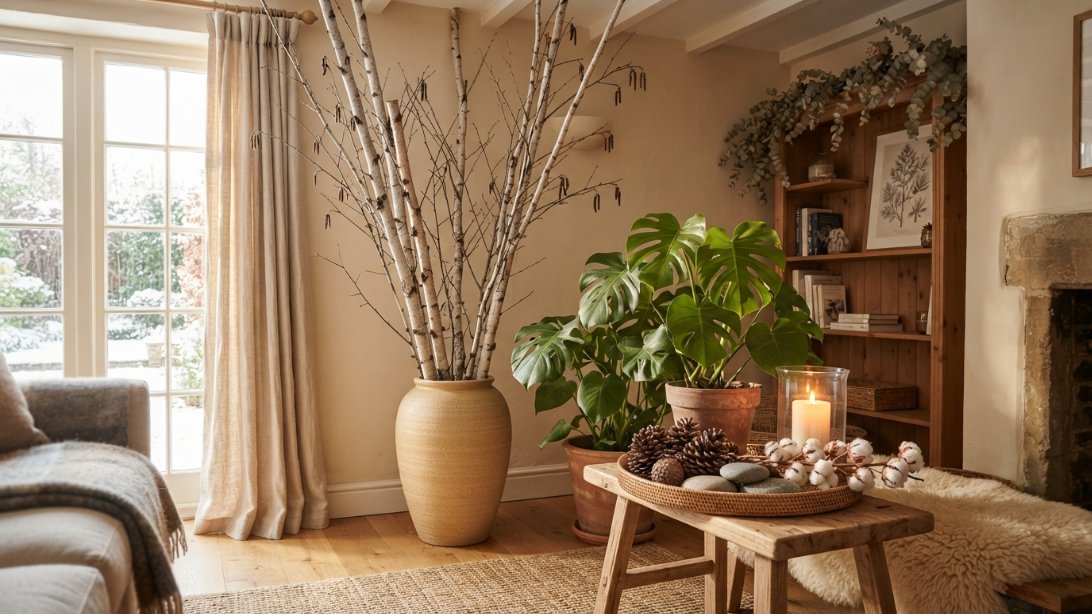
Natural elements in a winter living room serve the specific purpose of countering the visual bareness that winter creates outside: when the garden is dormant, the trees are bare, and the color palette outside the window is limited to grey, brown, and white, bringing living and natural elements inside provides the visual connection to the natural world that research consistently shows improves mood and wellbeing during the darker months.
Houseplants that thrive in winter indoor conditions include pothos, snake plants, philodendrons, peace lilies, and most tropical foliage plants that prefer the consistent warmth and indirect light that winter indoor environments provide. Grouping plants in one corner or on a plant stand creates a visual cluster that reads as a considered design element rather than a collection of individual plants distributed randomly. Large-scale plants including fiddle leaf figs, monstera deliciosas, and rubber trees provide the visual weight of a piece of furniture at a fraction of the cost while adding the specific quality of living texture that no decorative object replicates.
Branches and botanical materials provide natural texture without the care requirements of living plants. Bare branches in a large vase, specifically birch branches, curly willow, or eucalyptus stems from a grocery store or florist, provide organic line and height in a corner or beside a sofa where a plant stand might otherwise go. Dried botanicals including pampas grass, dried cotton stems, and preserved magnolia leaves provide similar organic texture with even less maintenance. Pine cones collected outdoors or purchased in bulk provide a free or very low-cost natural element that signals winter specifically through their scent and texture in ways that season-neutral decorative objects cannot.
5. Warm the Color Palette Seasonally
The easiest and least expensive way to shift a living room’s atmosphere from its three-season character to a winter-specific warmth is changing the color palette of the interchangeable elements: pillows, throws, candles, and small decorative objects that can be swapped seasonally without repainting walls or reupholstering furniture.
Winter color palettes that produce warmth without the specific holiday associations that limit their post-holiday appeal include deep jewel tones, burgundy, forest green, navy, plum, and mustard, that provide richness and depth. Warm neutrals, camel, terracotta, rust, ochre, and warm cream, provide a more subtle warmth that works alongside virtually any existing room color scheme. The combination of one jewel tone with two or three warm neutrals produces the layered, rich palette that winter rooms call for without the monotony of an all-neutral approach or the visual busyness of multiple saturated colors competing for attention.
Swapping summer cushions for winter versions is the most cost-effective and time-efficient seasonal update available. A set of four summer linen cushions replaced with four winter velvet cushions in warm tones costs $40 to $100 at IKEA, H&M Home, or Target and changes the immediate atmosphere of the room more dramatically than most more expensive alternatives. Storing summer textiles in vacuum-seal bags during winter reduces storage space required and keeps them fresh for the following year.
6. Add Scent as an Atmospheric Layer
Scent is the sensory dimension of room atmosphere that decorating guides most consistently undervalue, possibly because it is invisible and therefore feels less concrete as a design element. The research on scent and mood is among the most robust in sensory psychology: specific scent profiles reliably trigger warmth, comfort, and relaxation associations that directly contribute to the experience of a cozy room.
Winter-appropriate scent profiles that consistently register as warm and cozy rather than clean, fresh, or stimulating include:
- Woody and smoky: sandalwood, cedarwood, vetiver, amber
- Spiced and warm: cinnamon, clove, cardamom, vanilla, nutmeg
- Botanical and resinous: pine, fir, frankincense, eucalyptus
- Comforting and sweet: baked goods adjacent scents, warm apple, brown sugar, caramel
Candles from quality brands including Diptyque, Boy Smells, and Otherland at $40 to $60 provide scent alongside light for dual atmospheric contribution. More accessible options from Paddywax, Homesick, and Voluspa at $15 to $30 provide comparable winter scent profiles at more accessible price points. Reed diffusers provide continuous background scent without requiring active management of a candle flame. Essential oil diffusers allow custom scent blending and intensity control that candle-based scent delivery does not provide. Simmering spices on the stovetop, a combination of cinnamon sticks, cloves, star anise, and orange peel simmered in water on low heat, provides the most powerful and authentic winter scent experience of any option at a cost measured in cents rather than dollars.
7. Arrange Furniture for Conversation and Comfort
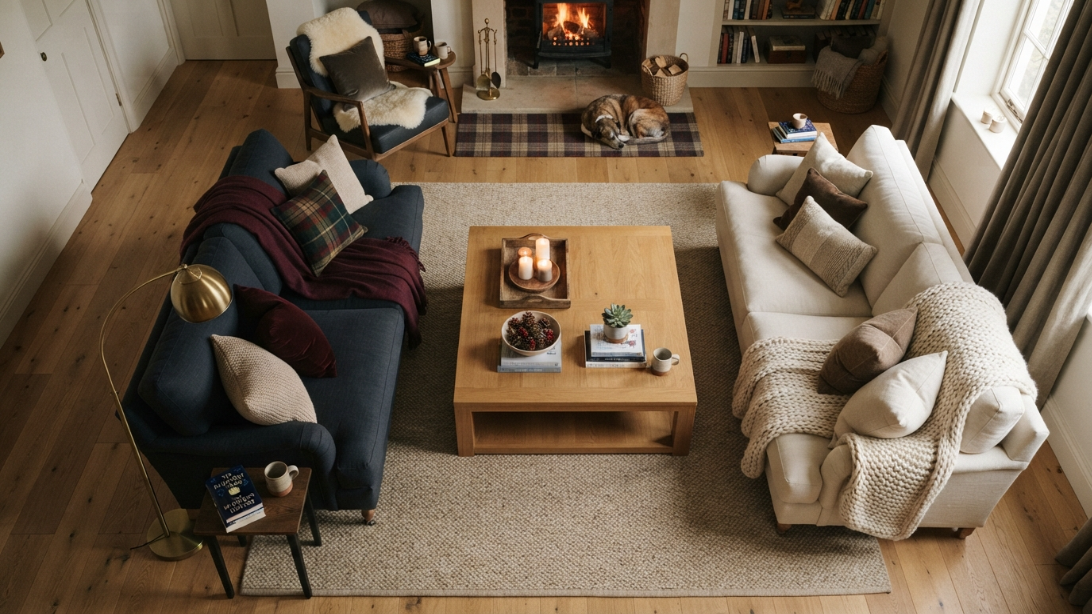
The arrangement of furniture in a living room determines whether the room functions as a comfortable, conversation-oriented gathering space or as a collection of individual seating positions oriented toward a television. Both are valid functions, but winter specifically calls for a furniture arrangement that supports the face-to-face conversation, shared activities, and general gathering that cold weather naturally encourages.
Floating furniture away from walls and arranging seating pieces to face each other across a shared coffee table creates the conversation pit effect that produces genuine social comfort. The conventional instinct to push furniture against walls to maximize floor space produces a room that feels larger but less intimate, which is the wrong trade for winter when the goal is shelter and gathering rather than spaciousness.
Creating a reading or sitting nook within the larger room provides a secondary destination within the space that adds the layered functionality that truly cozy rooms have: there is the main seating area, and there is the specific corner armchair with its own small table, lamp, and accumulated books that signals that the room is genuinely inhabited and enjoyed rather than maintained for display. An armchair positioned near a window with a floor lamp beside it, a small side table with a current book, and a throw over the arm creates this nook effect in the space of one chair and costs nothing beyond the positioning decision.
The coffee table serves as the room’s central gathering surface and benefits from specific styling for winter: a tray corralling candles, a small plant, and a coaster creates a composed center while leaving functional surface around it. A stack of coffee table books relevant to the season, a small bowl of pine cones or seasonal objects, and a candle in a vessel that suits the room’s aesthetic produce a styled but functional coffee table surface that enhances the room without requiring daily maintenance to look intentional.
8. Incorporate Warm Metals and Natural Wood Tones
The material palette of a room contributes to its warmth associations in ways that are less obvious than color but equally powerful in their cumulative effect. Cool materials including chrome, silver, glass, and white lacquer produce rooms that feel contemporary and clean but not warm. Warm materials including brass, copper, bronze, aged gold, walnut, oak, and terracotta produce rooms that feel grounded and warm even before textiles and lighting make their contributions.
Swapping cool-metal accessories for warm-metal alternatives is a targeted update that costs relatively little but changes the room’s material warmth significantly. A chrome picture frame replaced with a brass or aged gold frame, a stainless steel vase replaced with a copper or hammered gold alternative, and a chrome lamp base replaced with a warm brass version each make a small individual difference that accumulates into a meaningful shift in the room’s overall warmth temperature.
Exposed natural wood in furniture, decorative objects, cutting boards repurposed as display surfaces, wooden trays, and architectural elements like ceiling beams or wood paneling contributes a warmth that manufactured materials cannot replicate because of the historical association between wood and fire and shelter. A wooden tray on the coffee table provides warmth of material alongside the organizational function of corralling the objects on it. A live-edge wooden serving board propped against a wall or used as a display surface for candles adds organic texture that manufactured materials lack.
Budget-Conscious Approaches to Winter Room Transformation
Transforming a living room for winter does not require a decorating budget that reflects the seasonality of the project. Several high-impact changes cost very little and produce results that more expensive purchases occasionally fail to match.
Shop your own home first by moving objects from less-used rooms, guest bedrooms, and storage spaces into the living room for the winter period. A lamp from a bedroom that provides the right light quality but sits unused in a room that is rarely occupied, a throw from a guest room that adds the texture the living room needs, or artwork from a hallway that suits the winter atmosphere better than whatever is currently on the living room wall all provide impact at zero cost.
Natural materials from outside including branches, pine cones, stones, seed pods, and dried botanicals gathered during outdoor winter walks provide the organic texture and seasonal connection that purchased botanical decorations replicate at $30 to $50 per item. A collection of stones in a ceramic bowl, branches in a tall vase, and a small arrangement of gathered pine cones on a wooden board costs nothing beyond the time of the gathering and looks more genuinely connected to the natural world than their purchased equivalents.
Rearranging rather than replacing produces the single most dramatic transformation per zero dollars available in interior decorating. A living room where the furniture is moved to face each other around the fireplace or a central candle arrangement, where a rug from another room is added to layer the floor, and where lamps are repositioned from symmetrical flanking positions to varied heights and locations across the room will look genuinely different from its previous arrangement at no cost beyond the time and effort of the rearrangement.
Frequently Asked Questions
What are the most impactful top cozy living room decor ideas for winter season on a budget under $100?
A set of four velvet throw pillows at $10 to $15 each from Target or IKEA, a chunky knit throw at $20 to $30, four to six pillar candles at $2 to $4 each, and a bundle of eucalyptus from a grocery store or farmers market collectively cost $70 to $90 and produce the three highest-impact cozy room changes available: textile layering, candlelight, and natural botanical elements. These four additions address visual warmth, tactile warmth, ambient lighting, and scent simultaneously.
How do I make a small living room feel cozy without making it feel cramped?
Small rooms benefit from vertical visual interest that draws the eye upward rather than around the limited floor space: floor-to-ceiling curtains, tall plants, and stacked bookshelves all add dimension without consuming floor area. Warm lighting rather than bright overhead lighting makes a small room feel intimate rather than confined. A single large area rug rather than multiple small rugs simplifies the floor visually and makes the room feel more expansive. Furniture scaled to the room rather than oversized pieces that dominate the space allows the cozy elements of layering and warmth to register without the room feeling overwhelmed.
What colors make a living room feel coziest in winter?
Warm terracotta, deep burgundy, forest green, mustard yellow, camel, and rich navy consistently produce the warmest winter room atmospheres when used in textiles, paint, or decorative objects. The warm neutrals, specifically those with yellow and red undertones rather than blue and grey undertones, provide the most versatile foundation for layering winter seasonal color. Pure white and cool grey walls feel cold in winter unless offset with significant warm textile layering, warm-toned lighting, and natural material accessories that collectively shift the room’s color temperature toward the amber end of the spectrum.
Is it worth investing in a quality area rug for winter coziness specifically?
A quality wool or wool-blend area rug is the single highest-value winter living room purchase for rooms with hard floors, because it provides literal thermal insulation from cold floors, acoustic warmth through sound absorption, and visual warmth through its texture and color simultaneously. A quality rug from Loloi, Ruggable, or Safavieh at $150 to $400 for a standard living room size lasts ten to fifteen years with appropriate care and provides its winter benefit every year, which amortizes the investment to $15 to $40 per year of use.
How do I create a cozy living room atmosphere without buying anything new?
Rearrange existing furniture to face each other across a central point rather than orienting toward a television or the room’s perimeter. Move lamps from their current positions to vary the height and distribution of light sources across the room and turn off overhead lights in the evening. Gather and group existing throws and pillows from across the house onto the main seating. Arrange existing candles in clusters on a tray rather than distributing them individually. Move plants from other rooms into the living room to increase its living material presence. These five zero-cost changes address the primary principles of cozy room atmosphere and produce a meaningful shift in the room’s winter character without any new purchase.
Conclusion
A cozy winter living room is not a decorating project with a defined completion point. It is a gradual accumulation of warmth in the form of objects, light, scent, and arrangement that builds through the season and settles into exactly the right configuration somewhere around February when you realize you genuinely do not want to be anywhere else on a cold evening. Start with the lighting and the textiles, add the natural elements, and let the room tell you what it still needs. What is the first change you are making this weekend?