
Easy master bedroom decor ideas for romantic ambiance do not require a hotel budget, a professional decorator, or the kind of dramatic room transformation that looks great in a before-and-after photo and then slowly becomes impossible to maintain in real life. What they require is understanding what actually creates intimacy in a physical space, which turns out to be less about specific objects and more about specific qualities of light, texture, warmth, and sensory layering that most bedrooms never fully achieve because nobody sat down and thought about them deliberately. I have been in beautifully decorated bedrooms that felt completely cold and in simply furnished ones that felt immediately and deeply inviting, and the difference was almost always these qualities rather than the price of the furniture.
What Actually Creates Romantic Ambiance in a Bedroom
Romantic ambiance in a bedroom is not a mood board aesthetic. It is a physical and sensory experience that the room either produces or does not, and understanding what creates it at the neurological level helps you make better decorating decisions than following a trend ever does.
Warmth across multiple senses is the foundational quality. Visual warmth from amber-toned lighting and warm color palettes, tactile warmth from soft and layered textiles, thermal warmth from appropriate insulation and draft management, and olfactory warmth from scent all contribute simultaneously to a room that feels genuinely welcoming rather than decoratively correct. Addressing only one or two of these dimensions produces a room that looks romantic in photographs and feels incomplete in person.
Reduced visual complexity is the second quality, and it is counterintuitive enough to be worth explaining in detail. Romantic spaces consistently have fewer visible objects, simpler surfaces, and more deliberate negative space than the same rooms decorated without this intention. The brain in a visually complex environment stays in a mild state of alertness and processing that is incompatible with the relaxed, present-moment awareness that intimacy requires. Simplifying the visual field of a bedroom is not about minimalism as an aesthetic. It is about creating the neurological conditions that allow two people to actually be present with each other rather than vaguely distracted by the accumulated visual noise of their own room.
Sensory invitation is the third quality: surfaces and textiles that look so soft and inviting that touching them feels like a natural response rather than a deliberate choice, scents that register before visual analysis begins and immediately shift the room’s atmosphere, and sounds softened by textiles and soft surfaces that make the room feel quiet and private rather than acoustically exposed.
1. Transform Your Lighting Before Anything Else
Lighting is the highest-leverage single change available in any bedroom romantic ambiance project, because it simultaneously affects how the room looks, how objects within it appear, and the neurological state of the people in it. A bedroom with wrong lighting cannot be fixed by any other decorating decision, and a bedroom with right lighting makes everything else in it look better than it actually is.
Eliminate harsh overhead lighting as the primary evening light source completely and without compromise. Overhead lighting in a bedroom at full brightness produces the specific quality of light that offices and medical waiting rooms use because it keeps people alert and visually oriented. This is precisely what a romantic bedroom does not need. A dimmer switch on existing overhead lights at $15 to $30 in hardware converts an always-too-bright fixture into an ambient layer that can be reduced to a barely-there warm glow when the room needs to shift from functional to atmospheric.
Table lamps with warm bulbs on each nightstand provide the primary evening light at eye level, which the brain associates with warmth and shelter rather than the overhead light that mimics outdoor daytime. Bulbs at 2200K to 2700K produce the amber tone that reads as genuinely warm rather than the slightly blue cast of standard warm white at 3000K. IKEA, Target, and Wayfair all offer nightstand lamps between $25 and $80 that provide this function without requiring a significant investment.
Candles provide the specific flicker and amber quality that no electric source fully replicates and that the human nervous system responds to with a relaxation signal that is likely evolutionary in origin. A grouping of two to four pillar candles of varying heights on a dresser, a nightstand, or a dedicated candle tray creates the specific quality of moving warm light that makes a bedroom feel genuinely romantic rather than decoratively styled. Flameless LED candles from Luminara at $30 to $60 each produce a realistic flicker that is appropriate for nighttime use without fire risk.
Fairy lights or string lights used inside a bedroom provide a layer of soft ambient light that fills the space between larger light sources with a warmth and delicacy that no other lighting type produces. Draped behind a sheer canopy over the bed, arranged along the headboard wall, or placed inside a glass hurricane vase for a lantern effect, string lights add a specific quality of atmospheric warmth that contributes significantly to romantic ambiance at very low cost.
2. Build a Bed That Invites People to Stay
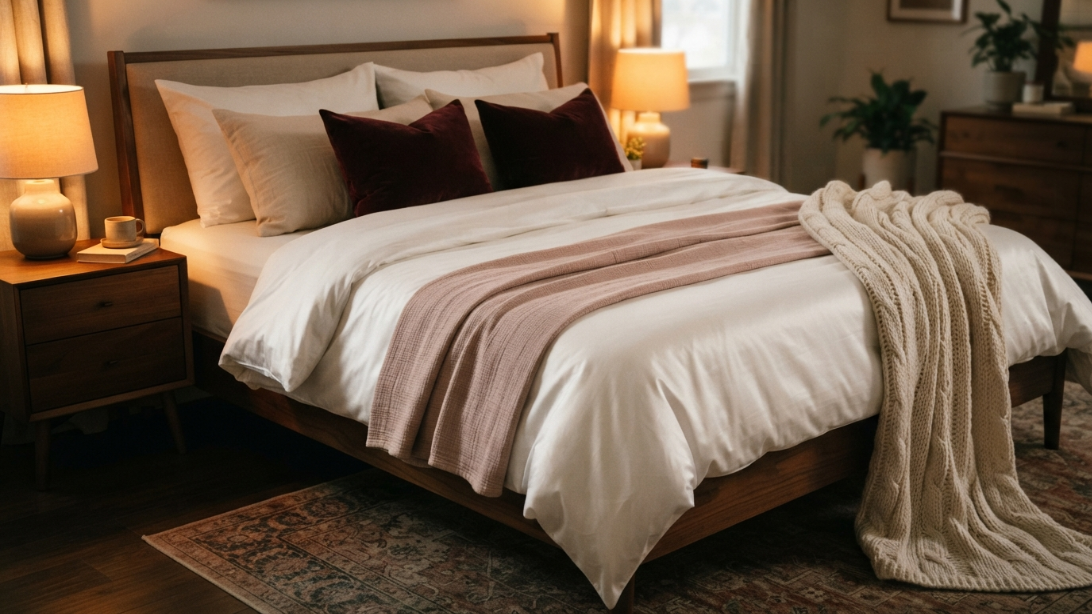
The bed is the visual and functional center of a master bedroom, and its composition communicates the room’s character before anything else registers. A bed that looks genuinely inviting, specifically soft, layered, warm, and beautiful, sets the entire tone of the room in a way that no other single element can.
A quality duvet or comforter is the foundation. For romantic ambiance specifically, down or down-alternative duvets at a loft sufficient to look generously full rather than flat provide the visual warmth and actual thermal comfort that cotton blankets and thin comforters cannot. A duvet that looks full and soft from across the room reads as an invitation before it is experienced as a texture. White or warm-neutral duvet covers in materials with visible texture, waffle weave, washed linen, or cotton sateen with a slight sheen, provide a clean, hotel-quality base that makes the bed look fresh without appearing cold.
Layering the bed beyond the duvet is what creates the genuinely luxurious and inviting quality that a single duvet never achieves alone. A lightweight decorative blanket or quilt folded across the foot of the bed, a throw casually arranged rather than geometrically placed, and three to five pillows in a combination of sleeping pillows in cases matching the duvet cover and two to three decorative pillows in textured fabrics all contribute to the layered quality that makes a bed look worth climbing into.
Pillow texture specifically matters for romantic ambiance: velvet, silk, satin, and boucle pillow covers in warm tones including dusty rose, burgundy, terracotta, warm cream, and deep navy all read as luxurious and sensual in a way that cotton and polyester alternatives do not. Two or three decorative pillows in these materials in front of the sleeping pillows cost $20 to $60 total from H&M Home, Target, or Amazon and transform the bed’s appearance more dramatically than that cost would suggest.
Easy Master Bedroom Decor Ideas for Romantic Ambiance Through Textiles
Textiles in a romantic bedroom function differently from textiles in any other room because they are not primarily decorative. They are the primary physical medium through which comfort, warmth, and sensory pleasure are delivered, and their quality relative to how they look and feel matters more here than anywhere else in a home.
Bedding Materials That Feel as Good as They Look
The specific materials used in bedding for a romantic bedroom affect both the visual quality of the made bed and the sensory experience of being in it, and the materials that look most romantic are not always the same as those that feel most comfortable.
Linen bedding has an organic texture and lived-in quality that becomes softer with every wash and that looks simultaneously casual and elegant in a way that pressed cotton never quite achieves. Brooklinen, Parachute, and Cultiver make genuinely excellent linen bedding at $100 to $250 for a full set. More accessible options from IKEA and H&M Home at $40 to $80 provide comparable visual quality with slightly less refined feel.
Satin or silk pillow cases add a specific tactile luxury to the sleeping surface alongside practical benefits for skin and hair that make them genuinely functional alongside their romantic aesthetic. A pair of Slip silk pillowcases at $80 to $100 provides the full benefit. Amazon Basics satin alternatives at $15 to $20 a pair provide a large portion of the visual quality and tactile experience at a fraction of the cost.
Window Treatments for Privacy and Atmosphere
Curtains in a master bedroom for romantic ambiance need to accomplish two things simultaneously: provide genuine privacy and light control when needed and contribute to the room’s atmosphere through their material and visual weight.
Floor-to-ceiling curtains in velvet are the single textile addition with the most dramatic romantic impact available in a master bedroom. The weight of velvet, its light-absorbing surface, its soft movement, and the sense of enclosure that heavy curtains create all contribute simultaneously to a room that feels more private, warmer, and more atmospherically rich. Velvet curtains from Amazon, Target, and IKEA in deep jewel tones including emerald, burgundy, navy, and plum start at $30 to $60 per panel and provide impact that genuinely exceeds their cost.
Blackout lining added behind a decorative curtain panel serves the practical function of sleep-quality darkness without requiring the decorative curtain itself to be blackout-rated, which allows the selection of more romantically appropriate fabric weights and colors without sacrificing the room’s functionality as a sleeping space.
3. Select a Color Palette That Feels Warm and Intimate
Color in a romantic bedroom performs a specific psychological function: certain color families reliably trigger associations with warmth, intimacy, and sensory pleasure that cooler, brighter, and more saturated colors do not. Understanding which colors produce these associations and why allows more informed choices than simply selecting what looks pretty in a sample chip.
Deep, rich tones with low saturation consistently produce the most romantic bedroom atmospheres: dusty rose, terracotta, warm burgundy, forest green, navy, plum, and warm taupe all have the depth that creates visual warmth without the visual aggression of bright, fully saturated versions of the same colors. These colors work best on walls or in large textile elements including bedding, curtains, and rugs where their depth reads as enclosure rather than heaviness.
Warm neutrals including ivory, warm cream, camel, and blush provide the most versatile romantic palette because they work alongside virtually every accent color, reflect warm-toned light beautifully, and create the clean but not cold background that makes candlelight and soft furnishings read as genuinely warm rather than isolated against a cold background.
Accent colors in a romantic bedroom should come from the same warm spectrum as the base palette rather than introducing cool-toned contrast: a warm cream base with dusty rose accents, a warm taupe base with terracotta accents, or a soft white base with burgundy and gold accents all maintain the warmth coherence that romantic ambiance requires. Cool-toned contrasts including bright white, grey, and blue-based neutrals interrupt this warmth coherence and produce rooms that look stylish but feel somehow disconnected.
4. Add Scent as the First Atmospheric Layer
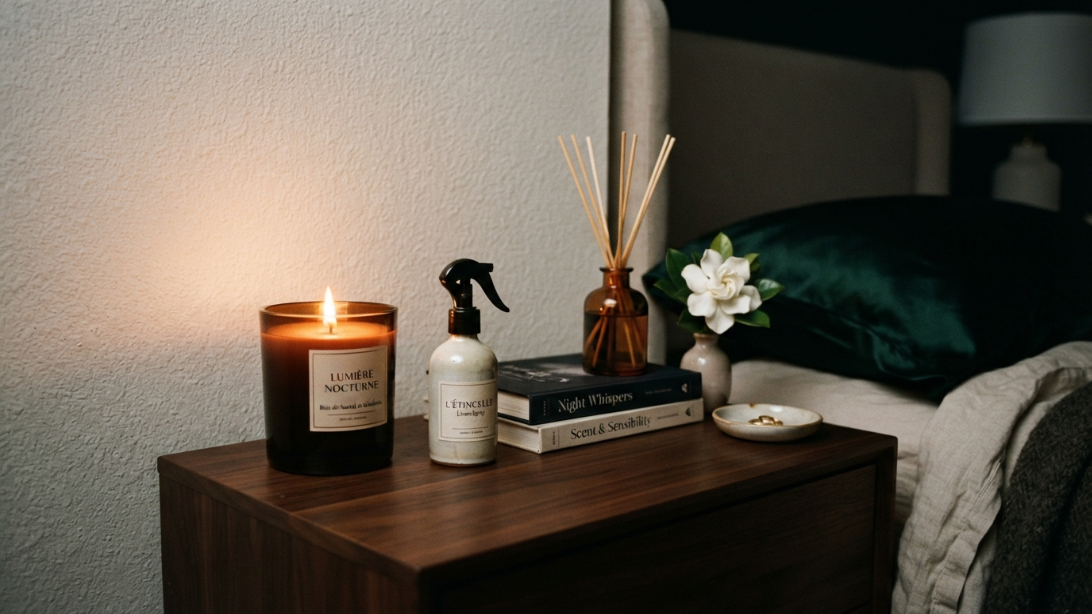
Scent reaches the brain faster than visual information because the olfactory system has a more direct neural pathway to the limbic system, the brain region responsible for emotion and memory, than any other sense. A bedroom that smells welcoming, warm, and sensual produces a positive emotional response before visual analysis of the room’s decor begins, which means scent is the most front-loaded atmospheric investment available.
Romantic bedroom scent profiles consistently use warm, complex, and slightly sweet notes that register as intimate rather than fresh, clean, or stimulating:
- Floral and warm: rose, jasmine, ylang-ylang, gardenia
- Woody and sensual: sandalwood, cedarwood, oud, vetiver, amber
- Spiced and warm: vanilla, cardamom, cinnamon, tonka bean
- Resinous and deep: frankincense, myrrh, benzoin, labdanum
Candles from quality perfume-forward brands including Diptyque Baies at $75, Boy Smells at $32, and Maison Margiela Replica candles at $70 provide the most sophisticated scent profiles available in candle format and are worth the investment for a bedroom that is used daily. More accessible alternatives from Voluspa at $20 to $28 and Paddywax at $18 to $24 provide genuinely good scent performance at prices that make daily use financially reasonable.
Linen spray applied to bedding before sleep combines the tactile experience of fresh bedding with a scent that transfers directly from the textile to the olfactory experience of being in bed, which is a more intimate delivery mechanism than a candle across the room. This Works Deep Sleep Pillow Spray at $30 and similar products from Aesop and L’Occitane deliver this effect. A DIY version using distilled water, a few drops of lavender and sandalwood essential oils, and a small spray bottle costs under $5 and provides equivalent functionality.
5. Create a Dedicated Relaxation Zone Beyond the Bed
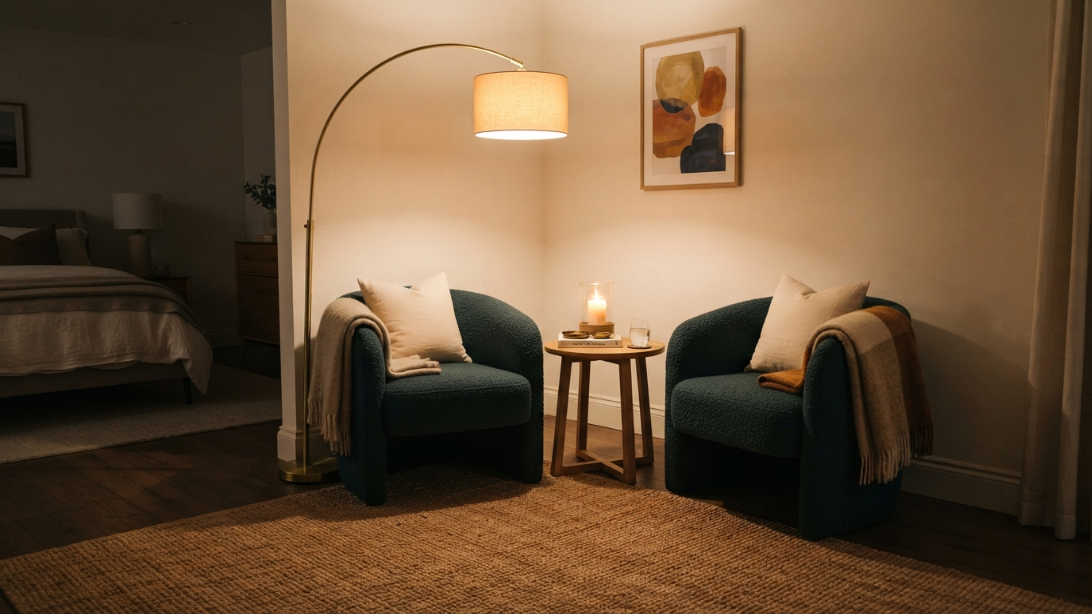
A master bedroom that contains only a bed and the furniture required to service it functions as a sleeping room. A master bedroom that contains a secondary seating area, however small, functions as a room where people choose to spend time together voluntarily rather than purely when sleep requires it.
A pair of armchairs with a small table between them in a corner of a master bedroom that has sufficient space creates a conversation area that functions as a private retreat within the private space of the bedroom. The specific combination of two chairs facing each other with a candle or lamp between them produces a genuinely intimate setting that the bed alone cannot provide because the bed is associated too primarily with sleep to register as a conversation space during waking hours.
A single armchair with a floor lamp and a small side table in a bedroom corner provides a reading and relaxation destination that adds to the bedroom’s identity as a place to be rather than only a place to sleep. The chair should be upholstered in a tactile material, velvet, boucle, or a soft woven fabric, and placed with a good lamp and enough surface for a drink and a book to make it genuinely functional rather than decorative.
A small upholstered bench or ottoman at the foot of the bed serves both the practical function of a surface for setting down clothing and the atmospheric function of completing the bed’s visual composition while providing seating that makes getting dressed in the morning more deliberate and less chaotic. A bench upholstered in velvet or a warm woven fabric at $80 to $200 from Wayfair, Target, or IKEA completes the bed arrangement in a way that a bare floor or folded blanket at the foot never fully achieves.
6. Use Natural Materials and Organic Textures
Natural materials in a bedroom produce a quality of warmth and groundedness that manufactured and synthetic alternatives approximate but never fully replicate, because the brain recognizes the variation and imperfection of natural materials as markers of the organic world that have been associated with warmth, shelter, and comfort across the full span of human experience.
Wood in headboards, nightstands, and decorative objects brings warmth through both its visual tone and its natural variation in grain and color. Walnut, oak, and reclaimed wood specifically provide the warm, dark, and slightly rough tones that suit romantic bedroom aesthetics better than the light, smooth, and uniform tones of birch and pine that dominate budget furniture. A wooden headboard in a warm-toned wood species is the single furniture upgrade most likely to shift a master bedroom toward romantic warmth, and options from Wayfair and Article at $200 to $500 provide genuine wood quality at accessible prices.
Woven textiles including rattan, jute, water hyacinth, and seagrass in basket, lampshade, and tray form add organic texture to a bedroom without competing with the softer textiles of bedding and curtains. A rattan lampshade on a nightstand lamp softens the light while adding texture. A woven tray on the dresser corrals perfume, jewelry, and daily objects while adding organic material variety to a surface that would otherwise be all smooth and manufactured.
Linen, cotton, and wool in their natural, minimally processed forms provide the specific combination of visual texture and tactile warmth that synthetic alternatives cannot replicate. Choosing natural fiber options for bedding, throw blankets, and decorative pillows consistently produces a more romantic tactile environment than their synthetic equivalents at comparable price points.
7. Incorporate Flowers and Living Elements
Fresh flowers in a master bedroom provide a combination of visual beauty, organic texture, color, and scent that no decorative object can replicate, and their impermanence means they require and reward attention in a way that permanent decoration does not. Buying fresh flowers for a bedroom is an act of deliberate care for the space that communicates intention and investment in the environment of the room.
A single stem vase on each nightstand with one or two flowers rather than an elaborate arrangement provides the flower presence without the arrangement cost. A single white peony, a garden rose, or a stem of eucalyptus in a small vase costs $2 to $5 per stem at most grocery stores and provides the organic beauty and scent contribution of a more elaborate arrangement. Trader Joe’s and Whole Foods regularly carry good-quality individual stems at accessible prices.
Dried botanical arrangements provide the organic beauty and texture of fresh flowers permanently: dried roses, pampas grass, dried lavender, and preserved eucalyptus last indefinitely without maintenance beyond dusting occasionally. A composed arrangement in a ceramic or glass vase on the dresser or beside the bed adds the organic quality of living material with the permanence of a decorative object.
A small potted plant with visual texture and a manageable care routine, specifically a peace lily that flowers indoors, a gardenia that provides extraordinary scent alongside its flowers, or a trailing pothos that adds organic movement to a nightstand or shelf, provides a living element that makes the bedroom feel inhabited and cared for in a way that purely decorative objects never quite achieve.
8. Edit and Simplify Everything That Is Currently There
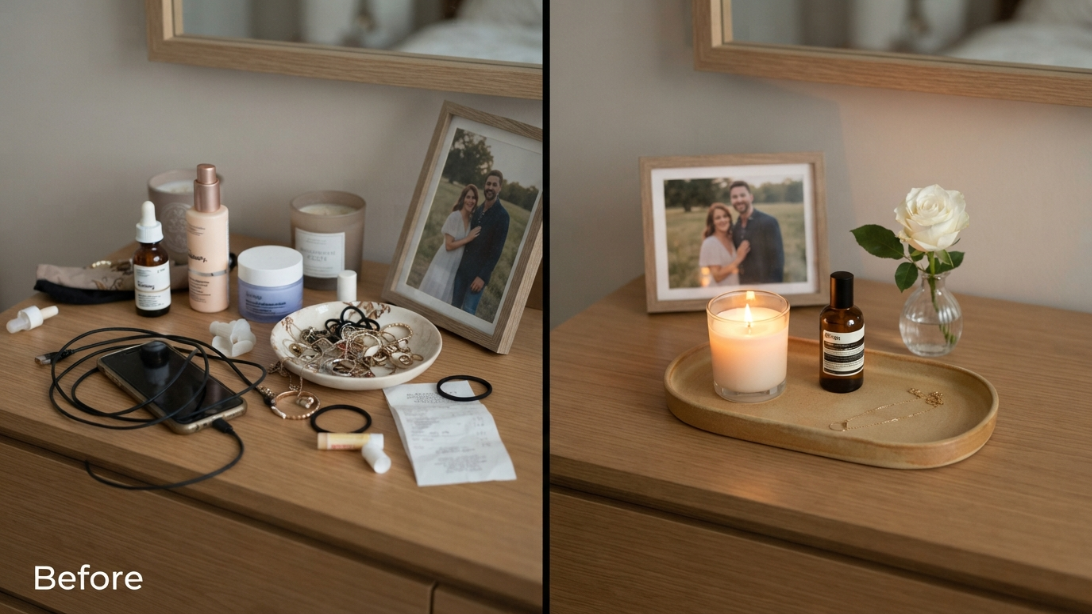
The most consistently overlooked easy master bedroom decor idea for romantic ambiance costs nothing and requires no purchase: removing objects, surfaces, and visual complexity that currently exist in the room and that collectively produce the baseline of visual noise that prevents intimacy from registering.
A bedroom desk or workspace is the specific object that most dramatically reduces romantic ambiance in a master bedroom, because it introduces the psychological associations of work, productivity, and obligation into a space that romantic ambiance requires to be associated exclusively with rest, pleasure, and connection. If a desk cannot be moved to another room, screening it from view with a room divider, curtain panel, or strategic furniture placement removes its psychological presence during the evening hours when it matters most.
Clothes on chairs, floors, and bed corners are the second category that most disrupts bedroom ambiance, because they signal unresolved domestic logistics in a space that romantic ambiance requires to feel resolved, organized, and deliberately chosen. A valet hook or small wall-mounted rod near the closet provides a designated home for transitional clothing that prevents the chair accumulation pattern without requiring perfect daily tidiness.
Flat surfaces cleared of accumulated objects make the room’s decorative choices register more clearly because they are not competing with clutter for visual attention. The nightstand that holds a lamp, a book, and one personal object looks more intentional and reads as more romantically considered than the same nightstand covered with charging cables, skincare products, half-full water glasses, and last week’s mail.
FAQs
What are the easiest master bedroom decor ideas for romantic ambiance on a tight budget?
Start with lighting: replace bulbs with warm 2200K to 2700K alternatives, add a dimmer switch, and place candles in a grouped arrangement. These three changes cost under $40 and produce more romantic atmosphere than most furniture purchases. Adding two velvet pillow covers and one throw from Target or H&M Home for $30 to $50 total makes the bed look significantly more inviting. Total budget under $90 for the highest-impact changes available.
What colors are most romantic for a master bedroom?
Dusty rose, deep burgundy, warm terracotta, forest green, navy, and warm cream consistently produce the most romantic bedroom atmospheres. The specific quality that makes these colors romantic is their warmth and depth rather than their specific hue: any color that reads as warm, slightly muted, and rich in tone contributes to romantic ambiance more effectively than its bright or cool-toned equivalent.
How do I create romantic ambiance in a small master bedroom?
Focus on the bed and the lighting first because in a small room those two elements dominate the visual field entirely. A beautifully layered bed with warm lamp light on each side and candles on the dresser produces romantic ambiance in a small room more effectively than attempting to create secondary seating zones that the space cannot accommodate without feeling cramped. Keep surfaces clear and reduce visual complexity more aggressively than you would in a larger room.
Is it worth investing in quality bedding for romantic ambiance specifically?
Yes, because bedding is the textile element that is both most visible and most physically experienced in a bedroom. High-quality linen or cotton sateen bedding looks better from across the room, feels better in use, and maintains its appearance through repeated washing better than budget alternatives. Brooklinen, Parachute, and Cultiver all offer trial periods or satisfaction guarantees that reduce the purchase risk.
What scents are most effective for romantic bedroom ambiance?
Sandalwood, rose, jasmine, vanilla, and amber are the scent profiles with the most consistent association with romance and intimacy across cultural and psychological research. Using a candle, diffuser, or linen spray in one of these profiles before the bedroom is used in the evening creates a conditioned association between the scent and the relaxed, intimate state of the bedroom that strengthens with repeated use.
Conclusion
Romantic ambiance in a master bedroom is built from the same qualities that make any intimate human environment work: warmth, comfort, sensory invitation, and the specific feeling that the space was arranged with care for the people who inhabit it. None of these qualities require expensive furniture or a complete renovation. They require attention, intention, and the willingness to remove what does not serve the room as much as you add what does. What is the first change you are making tonight?